THCa flower is the single most scrutinized product in the hemp market. It looks like cannabis, smells like cannabis, smokes like cannabis, and, once heated, it functionally is cannabis. The only thing separating it from what you'd find on a dispensary shelf is a line in the 2018 Farm Bill that measures delta-9 THC instead of total THC.
That one legal nuance created an entire industry. Growers who were already producing top-shelf cannabis realized they could cultivate the same genetics, harvest at the same stage, cure with the same care, and sell the finished flower nationwide so long as raw delta-9 THC stayed under 0.3%. What you're buying when you order premium THCa flower is a professional craft product — and its quality depends on dozens of decisions made months before it reached you.
This guide walks the entire chain. What THCa flower is. How it's grown, indoors, outdoors, and in greenhouses. Why harvest timing, drying, curing, and hand trimming are the variables that separate $25/eighth flower from $75/eighth flower. How to read a Certificate of Analysis. What strains to look for. How to store it. And where the law stands as of April 2026. By the end, you'll be able to evaluate any jar of THCa flower on its merits.
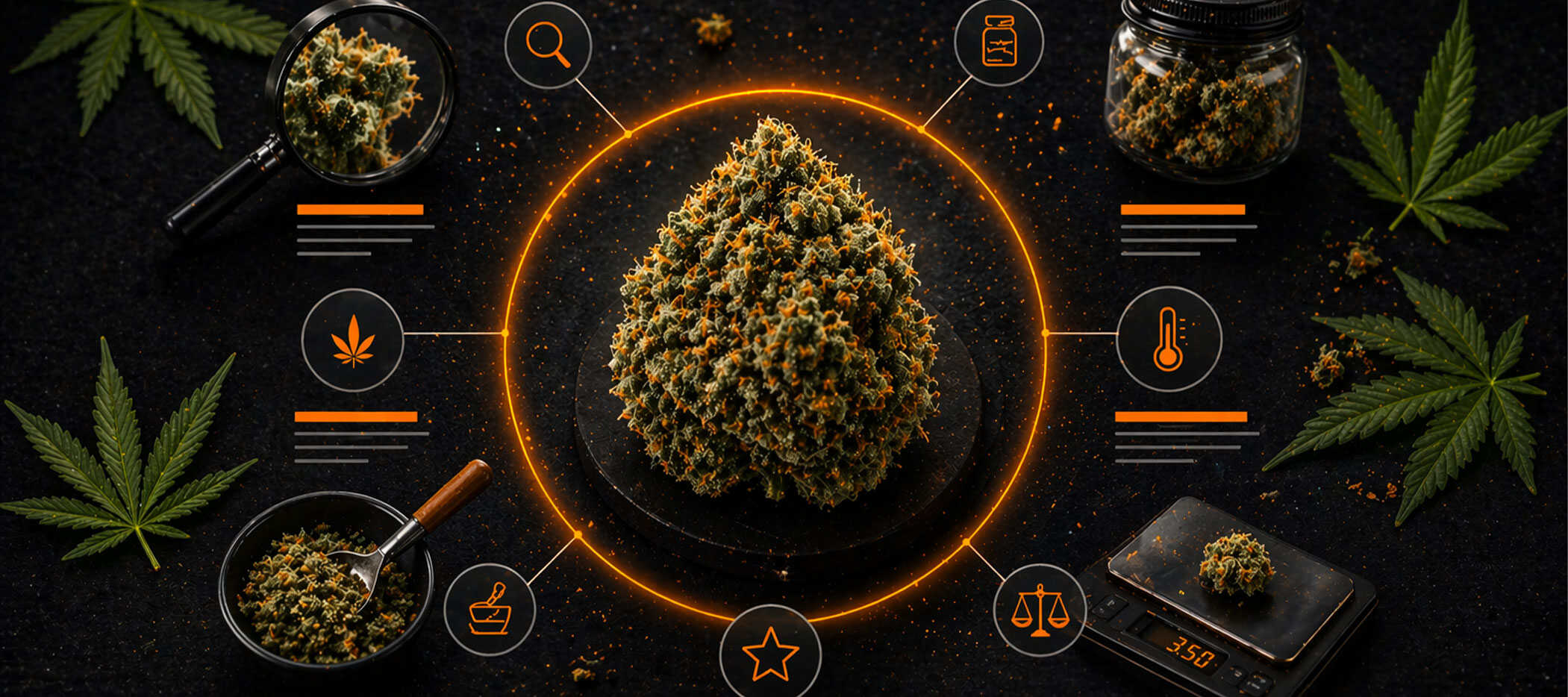
What Is THCa Flower?
THCa flower is dried, cured cannabis bud that contains high levels of tetrahydrocannabinolic acid (THCa) and less than 0.3% delta-9 THC by dry weight. THCa is the carboxylic acid precursor to delta-9 THC. In a living cannabis plant, almost all of the "THC" is actually THCa, which is non-intoxicating in its raw form.
When heat is applied — a lighter, a dab nail, a vaporizer coil, even a hot oven — THCa undergoes decarboxylation. It loses a carboxyl group as carbon dioxide and water and converts to delta-9 THC. That conversion is where the high comes from. Smoking THCa flower and smoking marijuana produce the same psychoactive effect because the molecule entering your lungs is the same in both cases.
For a deeper look at the chemistry and the distinction between the two cannabinoids, see our THCa vs THC guide. For a primer on what THCa is by itself, see What's THCa?.
The Farm Bill Logic
The 2018 Farm Bill defines legal hemp as Cannabis sativa L. with "delta-9 tetrahydrocannabinol concentration of not more than 0.3 percent on a dry weight basis." The key word is delta-9. Raw flower can test at 22%, 25%, even 30% THCa and remain federally compliant so long as its delta-9 THC stays under that line.
Compliance testing uses post-decarboxylation analysis, which predicts how much THC the flower would produce if fully heated. The formula labs use is straightforward.
- Total THC = (THCa × 0.877) + Delta-9 THC
- The 0.877 multiplier reflects the mass lost as CO2 and water during decarboxylation
- Federal rule measures delta-9 THC only, not total THC, in the flower as tested
- States increasingly regulate total THC — the practical reason some states restrict high-THCa flower
For the exact legislative text see Senate Bill 2754 on Congress.gov, and for federal enforcement guidance see the USDA Hemp Program.
How THCa Flower Is Grown: Seed to Harvest
Premium THCa flower is grown like any other high-end cannabis crop. The production chain breaks down into four phases: genetics, vegetative growth, flowering, and harvest prep. What happens in each phase determines what ends up in the jar.
Genetics and Starting Material
Growers either start from feminized seeds or clones. Clones guarantee the exact phenotype of a proven mother plant, which is why most top-shelf operations run them. Feminized seeds introduce variation but also genetic vigor. Either way, the cultivars selected for premium THCa flower are usually the same strains that dominate legal cannabis markets: Gelato, Runtz, OG Kush, Zkittlez, Wedding Cake, and modern exotics like Super Boof and Apples & Bananas.
- Clones: $5–$15 each at wholesale, ensure genetic consistency, require clean nursery stock free of pests and pathogens
- Feminized seeds: $8–$20 each, produce 100% female plants, express slight phenotype variation
- Autoflowers: faster (8–10 weeks seed-to-harvest) but generally lower potency, less common in premium flower
- Breeding target: high-THCa phenotypes that also stay under 0.3% delta-9 at compliance testing
Vegetative Growth
During veg, plants build the root system and canopy that will support heavy flower later. This phase typically runs 4 to 8 weeks. Lighting is kept at 18 hours on, 6 hours off, to hold the plant in vegetative mode.
- PPFD (photosynthetic photon flux density) target: 300–600 µmol/m²/s during veg
- VPD (vapor pressure deficit): 0.8–1.2 kPa for healthy transpiration
- Nitrogen-dominant feed; heavy focus on rooting and branching
- Topping, fimming, and low-stress training (LST) shape the canopy for even light penetration
Flowering Stage
When growers flip lights to 12 on / 12 off, the plant shifts into reproductive mode and begins producing flower. Flowering lasts 8 to 10 weeks depending on strain. This is where cannabinoid and terpene development happens.
- PPFD increases to 800–1500 µmol/m²/s; elite rooms supplement CO2 to 1000–1200 ppm
- VPD raised to 1.2–1.5 kPa to encourage tight internodal spacing
- Phosphorus and potassium increase; nitrogen tapers
- Temperature drop in final 2 weeks enhances purple and orange coloration (anthocyanin expression)
- Flush (pure water feed) typically begins 7–14 days before harvest to clear residual nutrients
For a deeper look at the full cultivation chain, see our full guide to how THCa flower is made.
Indoor vs Outdoor vs Greenhouse
The grow environment is one of the biggest factors in the final cost and character of the flower. Indoor, outdoor, and greenhouse each produce meaningfully different products.
Indoor THCa Flower
Grown entirely under artificial light in a climate-controlled room. Every variable — temperature, humidity, CO2, light spectrum — is dialed in. Yields run lower per plant (often 1–2 lb per 1000W light) but consistency is unmatched. Indoor flower typically has the densest buds, heaviest trichome coating, and tightest trim.
- Typical THCa: 22–30%+ in top-tier genetics
- Wholesale cost: $300–$800 per pound finished
- Pros: consistent batch to batch, maximum potency, year-round production
- Cons: highest operating cost per pound, highest energy footprint
Outdoor THCa Flower
Full-sun cultivation, one season per year, harvest in fall. Yields per plant are huge (3–7 lb or more) but the grower only gets one shot. Weather, pests, mold, and light contamination are real risks. Done well, sungrown outdoor flower has a uniquely complex terpene profile and can be as potent as indoor.
- Typical THCa: 18–26% at peak harvest
- Wholesale cost: $100–$300 per pound finished
- Pros: strongest terpene expression, lowest cost, smallest carbon footprint
- Cons: one harvest per year, exposed to weather and pest pressure, variable batch quality
Greenhouse and Light-Dep
A middle path. Plants grow in natural light but the greenhouse allows climate control, pest exclusion, and with automated light-deprivation tarps, growers can force multiple harvests per year by controlling the photoperiod. Light-dep greenhouse flower can rival indoor on potency with closer-to-outdoor economics.
- Typical THCa: 20–28%
- Wholesale cost: $200–$500 per pound finished
- 2–4 harvests per year possible with light-dep automation
- Closing the gap on indoor quality while keeping sungrown terpene complexity
For a deeper comparison see our full indoor vs outdoor THCa flower guide.
Harvest Timing: The Most Important Window in the Grow
Harvest is not a date. It's a target window, usually 3 to 7 days wide, where the plant's chemistry is at its peak. Cut too early and you lose potency and depth. Cut too late and cannabinoids start degrading to CBN, which shifts effects sedative and muddies terpenes.
Reading Trichomes
Trichomes are the tiny resin glands that produce cannabinoids and terpenes. Growers read them under a jeweler's loupe or digital microscope. They pass through three visual stages: clear, cloudy, and amber.
- Clear trichomes = cannabinoids still being synthesized, flower immature
- Cloudy (milky) trichomes = peak THCa production, ideal harvest window begins
- Amber trichomes = THCa degrading to CBN, more sedative effects, softer peak
- Most premium harvests target 80–90% cloudy, 10–20% amber on indica-leaning strains; more cloudy-dominant on sativa-leaning strains
- Pistil shift (white hairs darkening to orange/red and curling inward) is a secondary indicator
Effects of Timing
The same genetics harvested a week apart produce noticeably different experiences. Early harvest tends to feel lighter and more cerebral. Mid-window is the most balanced. Late harvest skews heavier, more body-focused, sometimes described as couchlock.
For the full breakdown of how harvest windows shape the final product, see our THCa flower harvest timing guide.
Drying and Curing: Where Flavor Is Made or Lost
Drying and curing are two separate post-harvest steps and they're the difference between good flower and great flower. Rushed or mishandled, even elite genetics come out harsh, hay-smelling, and stripped of terpene complexity.
Drying
After cutting, plants are hung whole or broken into branches in a dark drying room. The industry standard is the "60/60 rule" — 60°F and 60% relative humidity — held steady for 10 to 14 days. Too warm or dry and terpenes evaporate; too cool or humid and mold takes over.
- Target: 10–12% moisture content after dry
- Duration: 10–14 days typical for premium slow dry; 5–7 days for commercial speed
- Indicator: small stems snap cleanly but don't shatter when bent
- Drying too fast locks chlorophyll into the flower and produces the "hay" smell cheap flower has
Curing
After dry, flower is trimmed and moved to sealed vessels — glass jars, CVault stainless containers, or Grove Bags — for the cure. During cure, residual moisture redistributes through the bud, chlorophyll continues breaking down, and terpenes stabilize. Burping (opening containers to vent and swap air) happens daily the first week, less frequently after.
- Minimum: 2 weeks; premium standard: 30–60 days; top shelf: 60+ days
- Target RH inside container: 58–62% (Boveda packs at 62% are the standard humidity control tool)
- Burp daily during week 1, every 2–3 days week 2, weekly thereafter
- Grove Bags use passive humidity control and require no burping when sealed correctly
For the full drying and curing workflow, see our complete THCa flower cure guide.
Hand-Trimmed vs Machine-Trimmed Flower
Trimming removes sugar leaves and shapes buds. How it's done shows on the final flower. Hand trim is slow and expensive but preserves trichome-dense calyx surfaces. Machine trim is fast and cheap but tumbling action knocks off trichomes and compresses buds.
- Hand trim labor cost: $150–$300 per pound; trichome loss ~5%
- Machine trim cost: $20–$50 per pound; trichome loss 20–30%
- Visual: hand-trimmed buds retain shape, bract texture, and frosted surfaces; machine-trimmed buds look rounded, polished, and often smaller
- Hand trim signals premium at retail and justifies higher shelf pricing
- Some producers use hybrid "hand-finish" — machine trim with manual touch-up — as a middle path
For the full comparison see our hand-trimmed vs machine-trimmed THCa flower guide.
How to Recognize Quality THCa Flower
Premium THCa flower has a consistent quality signature. You can read most of it before you smoke.
- Trichome coverage: buds should look visibly frosted. Under a loupe, trichome heads should be intact and predominantly cloudy.
- Bud structure: indica-leaning strains dense and rounded; sativa-leaning strains looser and longer. Neither should crumble or feel spongy.
- Color: deep greens with contrasting pistils and occasional purple or violet pigmentation on late-harvested strains. Brown, yellow, or pale flower signals age, heat stress, or poor dry.
- Smell: loud, distinct terpene profile. You should be able to tell fuel, citrus, gas, dessert, or floral within seconds of opening the jar. No hay, no ammonia.
- Moisture: stems snap with a quiet crack; bud yields slightly to a squeeze and returns to shape. Dusty-dry or squishy-wet both fail.
- Trim quality: hand-trimmed shape, no over-trim into the bud, minimal sugar leaf.
- COA verification: every batch should have a current Certificate of Analysis listing cannabinoids, terpenes, pesticides, heavy metals, microbials, and mycotoxins from an ISO-accredited lab.
For the detailed buyer's checklist see our guide to spotting quality THCa flower.
Strains, Chemovars, and Terpenes
The old indica/sativa/hybrid split is increasingly considered marketing shorthand. Researchers now classify cannabis by chemotype (Type I = THC-dominant, Type II = mixed, Type III = CBD-dominant) and by terpene profile. Effects track terpenes more than indica/sativa labels.
Popular THCa Flower Cultivars
- Gelato: hybrid, 22–28% THCa, sweet and creamy terpene profile dominated by caryophyllene and limonene
- Runtz: hybrid, 20–27% THCa, candy-like terpene profile with caryophyllene and linalool
- OG Kush: indica-leaning hybrid, 20–26% THCa, fuel and pine-forward, myrcene and pinene prominent
- Jack Herer: sativa, 20–24% THCa, citrus and pine, terpinolene-dominant
- Blue Dream: sativa-leaning hybrid, 17–24% THCa, blueberry-herbal, myrcene and pinene
- Wedding Cake: indica-leaning hybrid, 22–27% THCa, vanilla and earth, limonene and caryophyllene
Terpenes Explained
Terpenes are the aromatic compounds that give each strain its distinct smell and contribute to its subjective effects. The same terpenes are found across plants — limonene in citrus peels, pinene in pine needles, linalool in lavender.
- Myrcene: earthy, musky; sedating, common in indica-leaning strains
- Limonene: citrus; uplifting and mood-elevating
- Caryophyllene: peppery; anti-inflammatory, binds CB2 receptors
- Pinene: pine; alertness, memory support
- Linalool: floral, lavender; calming
- Terpinolene: complex herbal; energizing, common in Jack Herer lineage
- Humulene: hoppy; appetite-suppressing, anti-inflammatory
- Ocimene: sweet, tropical; uplifting
- Bisabolol: chamomile; skin-soothing, anti-irritant
For a curated list of strains in stock see our strain library, and for a ranked guide see our best THCa flower strains of 2026.
Storage and Consumption
Storage
Even perfect flower degrades with bad storage. The enemies are heat, light, oxygen, and humidity extremes. Kept cool, dark, sealed, and at 58–62% RH, premium flower holds peak quality for 6 to 12 months before measurable terpene loss. THCa slowly converts to CBN over years, so old flower sedates harder than it intoxicates.
- Container: airtight glass jar or Grove Bag (TerpLoc-lined); avoid plastic bags long-term
- Humidity: Boveda or Integra 62% packs
- Temperature: 60–70°F; avoid fridge (condensation) and freezer (trichome shatter)
- Light: store in opaque container or in a drawer; UV degrades cannabinoids
For the full storage guide see our how to store THCa flower guide.
Consumption
The method of consumption changes the experience. Combustion (lighter, joint, pipe) converts THCa to THC fast and fully; dry herb vaporizers do the same at lower temperatures and preserve more terpene nuance.
- Joint or blunt: highest terpene loss from combustion, strongest traditional cannabis effect
- Glass pipe or bong: controlled combustion, water filtration cools and smooths smoke
- Dry herb vape: 350–400°F preserves terpene diversity, cleaner flavor, less intense but more layered effect
- Grinders matter: medium grind for joints, slightly finer for bowls, coarser for vapes
COAs, Testing, and Legality
How to Read a Certificate of Analysis
Every reputable retailer publishes a COA per batch. A legitimate COA comes from an ISO 17025-accredited third-party lab and lists the flower's cannabinoid and terpene content along with contaminant screens.
- Cannabinoid panel: THCa, delta-9 THC, CBD, CBG, CBN and usually 8–10 more — confirm THCa matches claim and delta-9 is below 0.3%
- Terpene panel: 20–40 terpenes, usually in mg/g; dominant terpenes should line up with the strain's stated profile
- Pesticide residue: California and Oregon hemp standards are the strictest benchmarks
- Heavy metals: arsenic, cadmium, lead, mercury — must be below parts-per-billion thresholds
- Microbials and mycotoxins: total yeast and mold, Salmonella, E. coli, Aflatoxins B1/B2/G1/G2, Ochratoxin A
- Batch and sample date: verify the COA matches the batch you're buying and is less than 12 months old
Legal Status (as of April 2026)
At the federal level, hemp flower under 0.3% delta-9 THC remains legal under the 2018 Farm Bill. However, federal negotiations around the reauthorization of the Farm Bill have moved toward a total-THC definition that would reclassify most high-THCa flower as controlled cannabis. That change has not been signed into law as of the time of writing but is actively being debated.
State rules vary widely. A handful of states have already adopted total-THC definitions (effectively banning high-THCa flower), some have explicit age and packaging requirements, and most allow direct-to-consumer sale under the federal hemp framework. Check your state's current statute before ordering; this is a rapidly moving legal landscape.
THCa Flower FAQ
THCa flower is dried, cured cannabis bud that contains high levels of tetrahydrocannabinolic acid (THCa) and less than 0.3% delta-9 THC by dry weight. It is federally compliant hemp under the 2018 Farm Bill. When heated, the THCa converts to delta-9 THC and produces the same effects as traditional high-THC cannabis.
Chemically, once heated, they are functionally the same. Genetically, premium THCa flower uses cannabis cultivars (Gelato, Runtz, OG Kush lineages, etc.) selected for high THCa expression. The only meaningful legal difference is the delta-9 THC percentage in the raw flower.
Harvest timing determines cannabinoid and terpene ratios. Cutting early captures lighter, more uplifting effects with dominant clear-to-cloudy trichomes. Cutting late delivers heavier, sedating effects as cloudy trichomes shift to amber. Miss the window and you lose THCa to degradation or terpenes to over-ripening.
Minimum two weeks. Most premium producers cure for 30 to 60 days. Some cure longer for top-shelf releases. A proper cure stabilizes terpenes, breaks down chlorophyll, and makes the flower noticeably smoother to smoke.
Indoor typically produces higher THCa percentages, denser bud structure, and more consistent quality batch to batch, which is why it costs more. Sungrown outdoor flower can be equally potent at peak harvest and usually has a richer terpene profile, but is more variable. Light-deprivation greenhouse sits between the two.
Federally, under the 2018 Farm Bill, hemp flower under 0.3% delta-9 THC is legal, and THCa content is not part of that limit. State law varies. Some states regulate total THC (THCa + delta-9), which restricts or prohibits high-THCa flower. Always check your state's current rule before buying or shipping.
Roughly 87.7% efficiency. A flower testing at 25% THCa produces about 21.9% delta-9 THC after decarboxylation. The remaining mass is lost as carbon dioxide and water during combustion or vaporization.
Key Takeaways
THCa flower is craft-grown cannabis sold under the federal hemp framework. Every variable in the grow — genetics, environment, harvest window, dry, cure, trim — shows up in the final jar.
Indoor cultivation produces the most consistent, trichome-heavy flower at the highest price point. Outdoor delivers richer terpenes and lower cost with more batch variation. Greenhouse and light-deprivation sit between the two.
Harvest timing is the single most important variable in the final experience. Trichome color and pistil shift tell a skilled grower when to cut. A few days early or late changes everything.
Drying (60/60 rule, 10–14 days) and curing (2–8 weeks in controlled humidity) are where flavor and smoothness are made. Hand trim preserves trichomes that machine trim knocks off, which is why premium flower is hand finished.
Quality shows in the jar before you light it. Trichome coverage, bud structure, color, smell, moisture, and trim quality are all readable. A current COA from an ISO-accredited lab is non-negotiable.
Legally, THCa flower is federally compliant so long as delta-9 THC stays below 0.3% by dry weight. State rules vary and the federal definition is being actively debated. Check your state before buying.
If you're looking for small-batch, hand-trimmed, COA-verified THCa flower, White Label Exotics sources premium THCa flower from California cultivators with third-party lab verification on every batch.
Ready to shop batch-verified THCa flower?
Discover WLX Products →