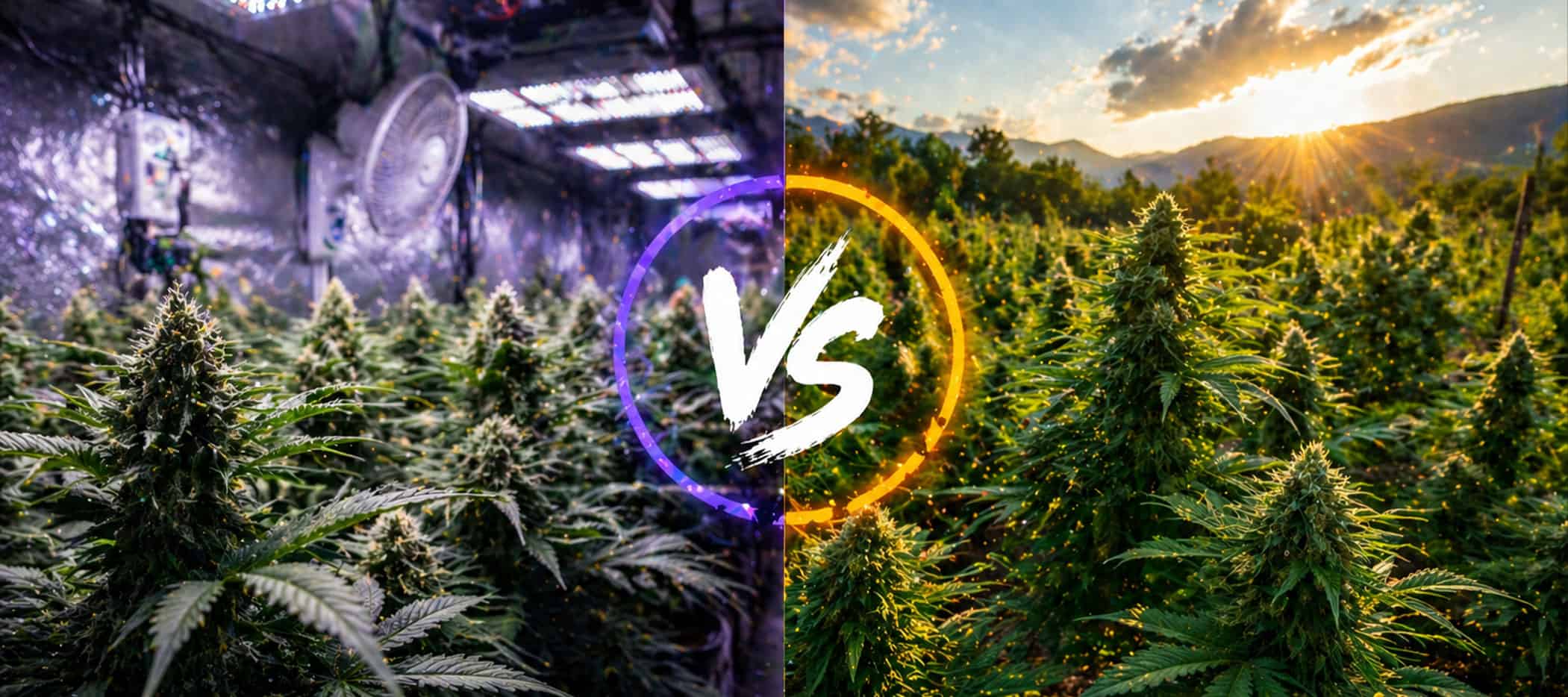
Walk into any serious cannabis conversation and "indoor" gets used as shorthand for "premium." It's not that simple. Indoor, outdoor, and greenhouse each produce legitimately different product — and the best examples of each rival the others on quality. What changes are the economics, the consistency, and the specific character of the flower.
This is an honest comparison of all three environments on the variables that matter: potency, terpenes, yield, cost, consistency, and visual signature. It builds on our complete guide to THCa flower.
Indoor THCa Flower
Indoor cultivation happens entirely under artificial light in a climate-controlled room. Every variable is engineered: light spectrum, intensity, temperature, humidity, CO2, airflow, even the nutrient schedule. The result is maximum consistency and maximum potency at maximum operating cost.
Potency and Yield
- Typical THCa: 22–30%+ in top-tier genetics
- Yield per 1000W light: 1–2 lb per harvest
- Harvests per year: 4–6 cycles possible with staggered rooms
- Trichome density: heaviest of the three environments; surface frost is signature
Cost, Pros, and Cons
- Wholesale cost: $300–$800 per pound
- Pros: consistent batch-to-batch quality, year-round production, maximum potency ceiling, pest and pathogen control, premium visual signature
- Cons: highest operating cost per pound, largest energy footprint (10–30% of total grow cost is electricity), requires expensive HVAC and lighting infrastructure
Outdoor (Sungrown) THCa Flower
Outdoor cultivation uses nothing but sunlight, soil, and seasonal weather. Plants go into the ground or large pots in spring, veg through summer, flower in late summer and early fall, and harvest in October. One season, one harvest, maximum exposure to everything nature throws at the crop.
Potency and Yield
- Typical THCa: 18–26% at peak harvest from a skilled grower; lower from hit-or-miss operations
- Yield per plant: 3–7 lb is typical; elite outdoor operations produce 8–15 lb per plant
- Harvests per year: 1
- Trichome density: good but generally looser than indoor; heavy terpene expression
Cost, Pros, and Cons
- Wholesale cost: $100–$300 per pound
- Pros: lowest production cost per pound, smallest carbon footprint, complex terpene expression from full-spectrum sunlight, biggest yields per plant
- Cons: one harvest per year, exposed to pest pressure (caterpillars, russet mites), weather risk (wind, rain, frost), bud rot risk in humid climates, variable batch quality
- Signature: fan leaves often still visible after trim, looser bud structure, oxidized orange pistils from sun exposure
Greenhouse and Light-Deprivation THCa Flower
Greenhouses use natural sunlight but add a structure and environmental controls. The key innovation for cannabis is light deprivation — automated blackout tarps or curtains that close over the greenhouse to block sunlight for 12 hours and force flowering earlier in the season. This lets cultivators run multiple harvests per year using sun as the primary light source.
Potency and Yield
- Typical THCa: 20–28% — closer to indoor than outdoor from well-run operations
- Yield per square foot: higher than indoor; lower than outdoor per plant
- Harvests per year: 2–4 with light-deprivation automation
- Trichome density: strong; often denser than straight outdoor
Cost, Pros, and Cons
- Wholesale cost: $200–$500 per pound
- Pros: combines natural sunlight's terpene benefits with controlled environment consistency, multiple harvests per year, lower energy cost than indoor
- Cons: higher capital investment than outdoor, temperature swings can be hard to manage in extreme climates, still exposed to some pest pressure
- Signature: dense indoor-like structure with a terpene depth closer to outdoor
Side-by-Side Comparison
If you line up the three on the variables that matter to a buyer:
- Potency ceiling: Indoor > Greenhouse > Outdoor
- Terpene complexity: Outdoor ~ Greenhouse > Indoor
- Visual signature (frost, density): Indoor > Greenhouse > Outdoor
- Batch consistency: Indoor > Greenhouse > Outdoor
- Cost per pound (low to high): Outdoor < Greenhouse < Indoor
- Carbon footprint (low to high): Outdoor < Greenhouse < Indoor
- Harvests per year: Indoor (4–6) > Greenhouse (2–4) > Outdoor (1)
None of these are absolute. A skilled outdoor cultivator running elite genetics on land with perfect climate produces flower that humbles most indoor operations. A poorly managed indoor room produces flat, harsh mids at premium prices. The grower matters more than the environment.
How Environment Shapes the Bud
The environment a plant is grown in changes its expression in predictable ways, even when you run the same genetics.
- Light: full-spectrum sunlight drives broader terpene synthesis than even the best LEDs. Indoor LED lighting concentrates on photosynthetic wavelengths but misses the UV and far-red bands that trigger some secondary metabolite production.
- Soil vs substrate: soil-grown plants pull from a living microbiome that interacts with root exudates. Indoor hydroponics or coco coir deliver precise nutrients but without the microbial complexity.
- Temperature swings: natural day-night temperature deltas (often 20°F+ outdoors) signal the plant differently than tight indoor swings (5–8°F).
- Wind stress: outdoor plants exposed to wind build thicker stems and often denser buds at branch tips.
- Finish time: outdoor plants usually finish 1–2 weeks later than their indoor counterparts because of lower DLI (daily light integral). The slow finish can produce heavier terpene loading.
What You're Actually Paying For
The price gap between indoor and outdoor flower isn't a gap in potency alone. It reflects different underlying costs.
- Energy: indoor grows consume 200–400 kWh per pound produced; outdoor approaches 0
- Labor: indoor requires continuous staffing (trimming, transplanting, IPM); outdoor concentrates labor in spring and fall
- Facilities: indoor requires HVAC, lighting, dehumidification, CO2 supplementation; outdoor needs minimal infrastructure
- Risk: outdoor flower's price discount prices in weather and pest risk a retailer absorbed at harvest
None of this tells you what will taste or hit better. Buying on cost-of-production assumptions ignores the craft. Good flower comes from a skilled grower regardless of environment. See how to spot quality THCa flower and read COAs carefully.
Which Should You Buy?
It depends on what you want from the flower.
- Maximum potency and visual signature: indoor, ideally hand-trimmed with a 30+ day cure
- Richest terpene profile at the lowest price: outdoor from a known skilled cultivator, freshly cured
- Best overall value (quality-to-cost): light-deprivation greenhouse from a reputable farm
- Consistency across reorders: indoor from a single-batch source
- Seasonal specialty releases: outdoor fall harvest or light-dep summer runs
Many premium retailers carry all three. Your best move is to buy a small quantity of each from the same vendor and compare them head to head on your own palate.
Frequently Asked Questions
On average, yes — typically by 2 to 5 THCa percentage points. Top-tier indoor flower hits 25-30%+ THCa while most outdoor peaks at 18-26%. But the best outdoor flower from a skilled cultivator can match indoor potency.
Indoor operations run HVAC, lighting, and CO2 year-round and produce lower yields per plant. Outdoor runs on sunlight, one harvest per year, with bigger yields. Energy and labor inputs per pound are roughly 3-5x higher for indoor.
Not inherently. Sungrown flower from a skilled outdoor cultivator often has richer terpene expression than indoor. It's typically less consistent batch to batch and has looser bud structure, but quality is determined by the grower more than the environment.
Greenhouse cultivation that uses blackout tarps to force flowering by blocking sunlight for 12 hours. This lets cultivators produce 2-4 harvests per year while using natural light, splitting the difference between indoor consistency and outdoor terpene richness.
Outdoor tends to produce the most complex terpene profiles because full-spectrum sunlight, soil microbiome, and a slow finish produce secondary metabolites indoor setups rarely replicate. Indoor often has louder, cleaner single notes. Greenhouse sits between.
Indoor buds are typically denser, tighter, and more uniform with heavy trichome frost. Outdoor buds are looser with larger fan leaves still present after trim. Greenhouse falls in between — structure closer to indoor, surface finish closer to outdoor.
Key Takeaways
Indoor, outdoor, and greenhouse are three legitimate paths to premium THCa flower. Each produces meaningfully different character for meaningfully different cost. The grower matters more than the environment, but the environment absolutely shapes the final product.
Indoor delivers the highest potency ceiling, the tightest consistency, and the most engineered visual signature — at the highest price. Outdoor delivers the deepest terpene complexity and the lowest cost, with real batch variability. Light-deprivation greenhouse is the efficient middle path and increasingly where craft cultivators are landing.
If you care most about THCa percentage and frosty visual, indoor is your category. If you care most about terpene nuance, sungrown and greenhouse deserve the first look. The best strategy is to try the same strain across environments from a trusted source and let your own palate decide.
For the full overview of THCa flower production, see our complete guide to THCa flower. To shop flower from California cultivators across all three environments, browse the WLX THCa flower lineup.
Ready to shop batch-verified products?
Discover WLX Products →