Every serious cultivator will tell you the same thing: the day you chop defines the flower more than any other decision you make. Genetics, environment, nutrients, training — all of that is the setup. Harvest timing is the shot. A 3-day swing in either direction produces a different product with the same genetics from the same room.
This guide walks through why timing matters at a chemistry level, how professional growers read the plant to identify the peak window, and what early, on-time, and late harvests actually feel like. It builds on our complete guide to THCa flower and goes deeper on this single stage.
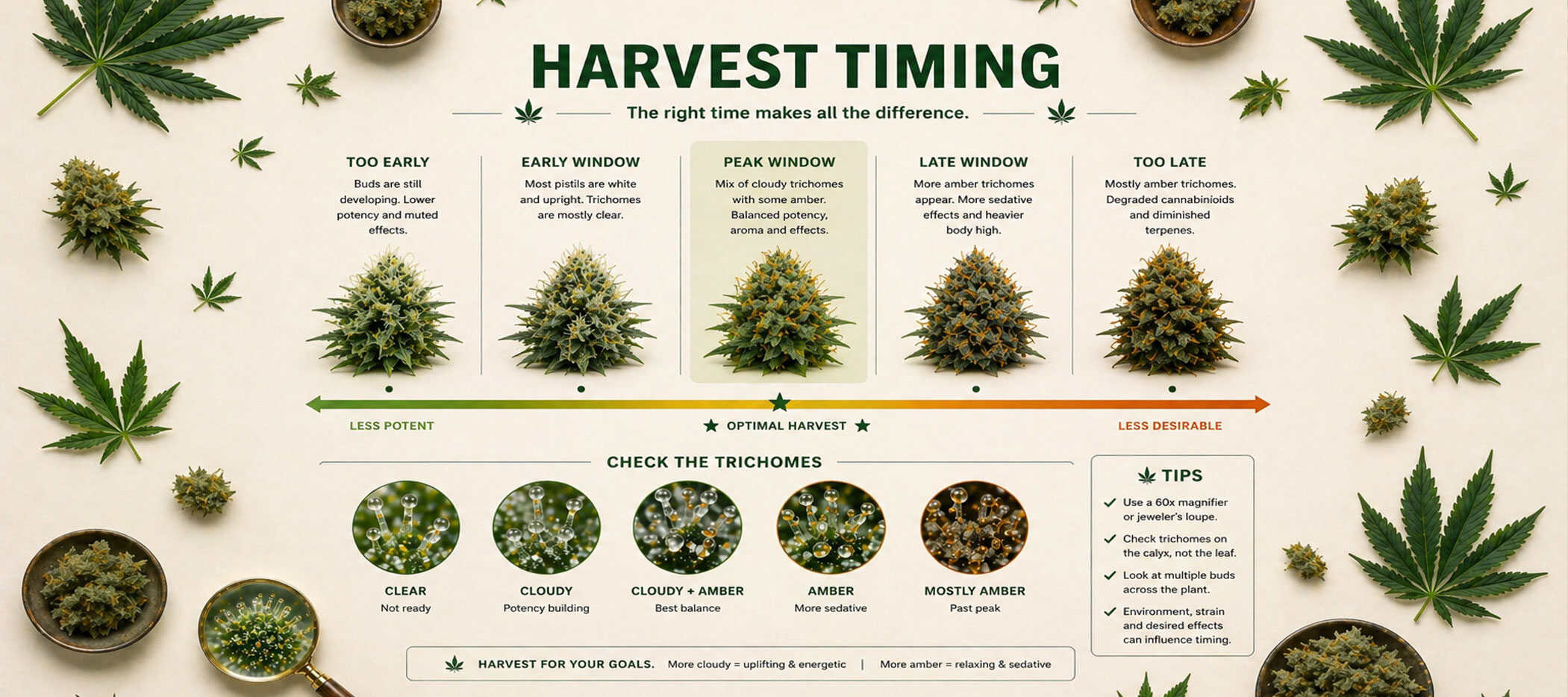
Why Harvest Timing Matters
During flowering, the plant continuously synthesizes cannabinoids and terpenes inside trichome heads. Production ramps up week by week, peaks during the final 1–2 weeks, then starts reversing as cannabinoids degrade into other compounds.
- THCa production peaks toward the end of flower, then starts converting to CBN over time
- Terpene synthesis peaks earlier than THCa for some compounds and later for others; profiles shift throughout the final weeks
- Pistils receive and then shed signaling; fan leaves senesce (yellow and wither) as the plant finishes
- Bud density continues increasing in the final 2 weeks as buds swell and trichomes multiply
A skilled grower reads all of this and picks the day when the target ratios are best. Miss by a week either way and the flower is a noticeably different product.
How to Read Trichomes
Trichomes are the tiny glandular stalks on the bud surface that produce cannabinoids and terpenes. Under magnification (30x loupe or USB microscope minimum; 100x+ ideal) they pass through three visible stages.
- Clear: trichome heads are transparent. Cannabinoids still being synthesized. Flower is not ready.
- Cloudy (milky): trichome heads turn translucent white. Peak THCa production. Harvest window opens.
- Amber: trichome heads turn yellow-brown as THCa starts degrading to CBN. Effects shift sedative.
Cultivators check multiple spots on the plant — upper colas, mid-canopy buds, and lower sites — because trichomes don't all mature at the same rate. The target ratio is usually expressed as percentages across the whole plant.
Target Ratios by Strain Type
- Sativa-leaning strains: 90%+ cloudy, <5% amber. Cut earlier to preserve uplifting clarity.
- Balanced hybrid: 80–90% cloudy, 10–15% amber. Most versatile window.
- Indica-leaning strains: 70–80% cloudy, 15–25% amber. Let more amber develop for fuller body effects.
- CBD-dominant hemp: similar logic but pushed slightly later; CBD degrades more slowly than THCa
These are guidelines, not rules. Experienced cultivators adjust based on the specific cultivar's chemistry and the market they're selling into.
Pistil and Visual Cues
Pistils (the hairs growing from calyxes) are a secondary indicator. They start white, erect, and outward-facing, then darken to orange, red, or brown and curl inward as the bud matures. Most cultivars are ready when 60–90% of pistils have darkened and curled.
Other visual tells that complement trichome reading:
- Fan leaves yellowing and dropping (senescence) indicates the plant is finishing
- Calyxes (the small bract-like structures) swelling and filling out indicates bud swell
- Purple and violet pigmentation deepening in cold-finish strains as anthocyanin expresses
- Resin overall appearance: a sheen that makes buds look frosted from several feet away
For a deeper look at the full cultivation stages leading up to harvest see how THCa flower is made.
Early, On-Time, and Late Harvest Compared
Three cuts of the same plant a week apart produce three noticeably different flowers. Here's what each produces.
Early Harvest
- Trichome state: mostly clear with some cloudy
- THCa %: below genetic potential, often 2–5% lower than peak
- Effects: light, cerebral, brief; minimal body effect
- Terpenes: underdeveloped, lighter on heavier terpenes like myrcene
- Yield: reduced; buds haven't fully swollen
- Use case: micro-dosers or cultivators who prefer pure sativa expression
On-Time Harvest (Peak Window)
- Trichome state: 80–90% cloudy with 10–20% amber (strain-dependent)
- THCa %: genetic potential realized; highest measured potency
- Effects: balanced, matching the strain's intended profile
- Terpenes: fully expressed, loud, complex
- Yield: maximum bud mass
- Use case: standard premium THCa flower
Late Harvest
- Trichome state: 30%+ amber; some cloudy trichomes degrading visibly
- THCa %: degrading; some converted to CBN
- Effects: sedative, heavy body, couchlock-dominant; shorter-lasting peak, longer tail
- Terpenes: shift toward musty, over-ripe; fresh notes fade
- Yield: slight bud loss from calyx damage and lower plant viability
- Risk: mold (bud rot) rises sharply in humid conditions
- Use case: nighttime or sleep-focused indica releases
Commercial vs Craft Harvest Decisions
Commercial operations face a tension. A 3-day-earlier harvest means 3 more days of cash flow and 3 fewer days of labor and risk. A 3-day-later harvest often means slightly higher THCa but also slightly more risk. Some large operations harvest 2–5 days before peak to reduce mold risk and standardize across rooms.
Craft operations typically wait for the window. They can afford the patience because their product commands the price. This is one of the invisible reasons premium flower hits differently — the grower waited while the commercial grower chopped.
Selective vs Whole-Plant Harvest
Not all buds on a plant mature at the same rate. Upper colas (the dominant top buds) get the most light and ripen first. Lower buds (often called larf or B-buds) ripen 3–10 days later. Two strategies:
- Whole-plant chop: cut the entire plant at once. Simpler logistics, some upper or lower buds are slightly off-peak, standard for most commercial grows.
- Selective harvest: cut upper colas first, let lower buds finish another 3–10 days. Higher labor cost, higher per-bud quality, often used by boutique indoor cultivators.
Compliance Testing and the Harvest Window
For THCa flower, timing also has a compliance dimension. The federal hemp rule requires pre-harvest testing within 30 days of harvest, and flower must test below 0.3% delta-9 THC. Delta-9 THC can creep up late in flower as THCa slowly converts even in the live plant. Cultivators balance maximum THCa against compliance risk.
- Federal hemp sampling window: within 30 days of harvest
- Testing method: post-decarboxylation analysis calculates total THC from THCa + delta-9
- Pass threshold: delta-9 THC ≤ 0.3% dry weight
- Late-flower delta-9 creep can push otherwise-compliant crops over the line if harvest drags
See the federal USDA Hemp Program testing rules for the full sampling protocol.
Frequently Asked Questions
By reading trichome color under a loupe or microscope. Most cultivators target 80-90% cloudy and 10-20% amber trichomes, checking daily in the final 2 weeks of flower. Pistil color shift (white hairs darkening and curling in) is a secondary confirmation.
Potency is immature — THCa percentage is below what the genetics could deliver and terpenes are underdeveloped. Effects tend to feel lighter, more cerebral, and shorter-lasting. Yield is also reduced because buds haven't fully swollen.
THCa starts degrading to CBN, which produces heavier, sedative effects and less of the euphoric high people expect. Terpene expression also shifts — fresh, bright notes mellow into over-ripe and musty. Mold risk rises in humid climates.
Typically 3 to 7 days. The plant reaches peak chemistry for roughly a week before cannabinoids and terpenes start degrading. The skilled grower's job is to identify that window and cut within it.
Significantly. Early harvest skews toward uplifting and clear. Mid-window harvest is the most balanced. Late harvest skews body-heavy and sedating because more THCa has degraded to CBN and some cannabinoids shift.
No. Sativa-leaning strains are usually cut earlier in the cloudy stage to preserve cerebral clarity (minimal amber). Indica-leaning strains are cut later to let more amber develop for deeper body effects. Strain-specific windows matter.
Key Takeaways
Harvest timing is the single most leveraged decision in a THCa flower grow. A 3-7 day window separates peak flower from under-ripe or over-ripe flower. Everything about the final experience — potency, effects, terpene profile — rides on it.
Trichome color (clear → cloudy → amber) is the primary indicator. Target 80–90% cloudy with 10–20% amber for most balanced hybrids, earlier for sativa-leaning strains, later for indica-leaning strains. Pistil shift and fan-leaf senescence are secondary confirmations.
Early harvest under-delivers potency and effect. On-time harvest realizes genetic potential. Late harvest shifts the experience sedative as THCa degrades to CBN.
For THCa flower specifically, compliance timing adds a wrinkle: delta-9 THC can creep up late in flower and push a crop over the 0.3% federal limit. Cultivators balance maximum potency against compliance risk.
For the full overview of THCa flower, see our complete guide to THCa flower. For what happens after harvest, see our drying and curing guide. To shop batch-verified THCa flower cut at peak, browse the WLX THCa flower lineup.
Ready to shop batch-verified products?
Discover WLX Products →