If you're searching for "THCa vs THC," you're likely asking one of three questions: What's the actual difference? Will they show up the same on a drug test? Which one is legal in my state?
These are legitimate questions. The distinction between THCa (tetrahydrocannabinolic acid) and THC (delta-9-tetrahydrocannabinol) determines everything from product potency to legal status to drug test results. This guide walks through the chemistry, effects, legality, and real-world product implications.
By the end, you'll understand why raw THCa flower won't get you high, why heating it does, why both are tested for legal compliance, and what product format fits your needs.
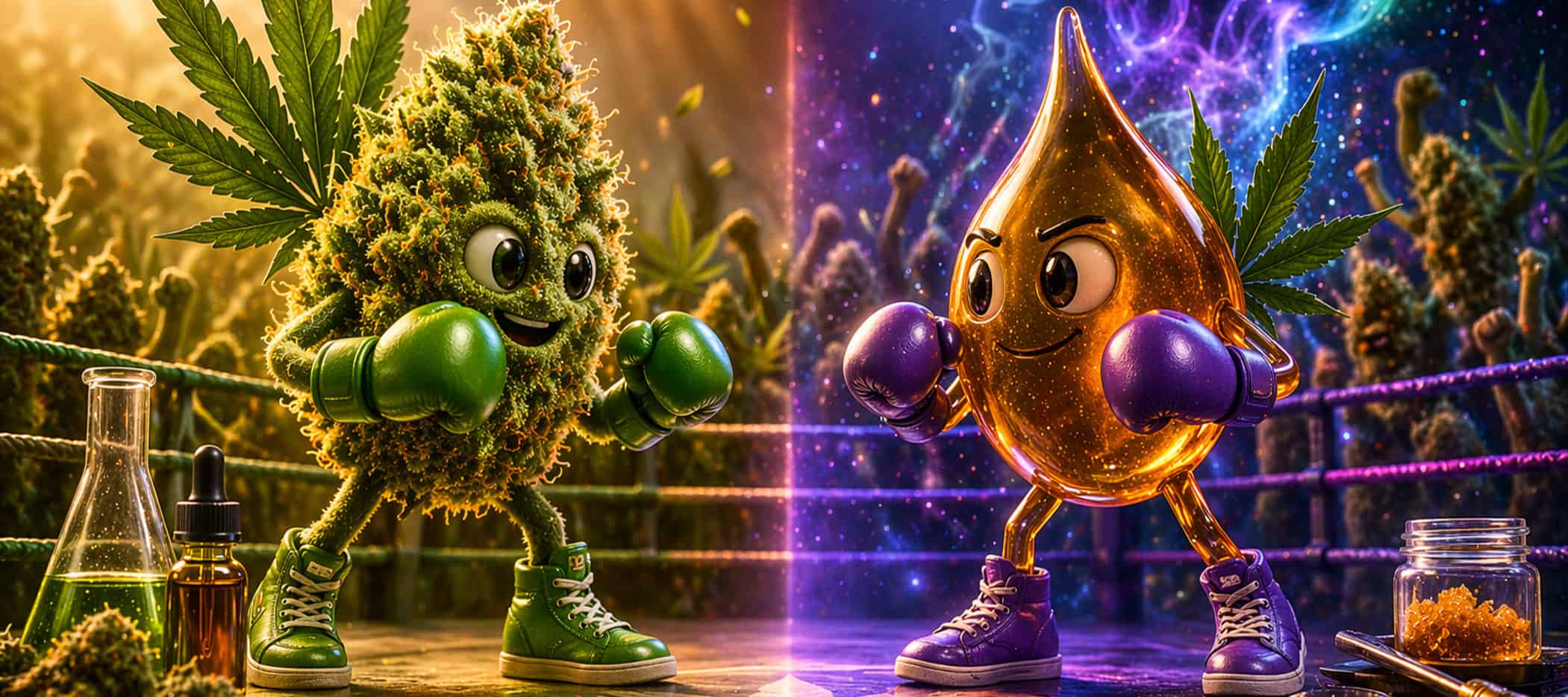
THCa vs THC: The Chemical Difference
The core distinction is molecular structure. THCa contains a carboxyl group (COOH) attached to its ring structure. THC does not. This single chemical difference controls whether the molecule interacts with your CB1 receptors, which is your brain's primary cannabinoid receptor.
The carboxyl group makes THCa non-intoxicating. Your CB1 receptors don't recognize it as a psychoactive agent. THC, without that carboxyl group, fits into CB1 receptors and produces the effects you associate with cannabis.
The conversion between THCa and THC happens through decarboxylation—heating. When you apply heat (smoking, vaping, cooking), the carboxyl group breaks off as carbon dioxide and water. What remains is THC. This process is irreversible.
THCa vs THC: Molecular Breakdown
- THCa (tetrahydrocannabinolic acid): Contains COOH carboxyl group, non-intoxicating, does not bind to CB1 receptors, raw/unheated form
- THC (delta-9-tetrahydrocannabinol): Lacks carboxyl group, intoxicating, binds to CB1 receptors, produced via decarboxylation (heat)
- Conversion rate: 1 mg THCa converts to approximately 0.877 mg THC when fully decarboxylated
- This is why product labels state "THCa" separately from "THC" — they're measured independently but can interconvert
- The endocannabinoid system (ECS) regulates immune response, inflammation, pain signaling, and mood — but only THC directly activates CB1 in this pathway
THCa vs THC: Effects Comparison
The effects profile is where most confusion happens. People see "high THCa" on a product label and assume it behaves like high-THC cannabis. It doesn't — unless heat is applied.
THCa Effects (Raw Form)
Raw THCa flower, dabbing raw THCa concentrate, or consuming unheated cannabis juice won't produce intoxication. Your CB1 receptors don't interact with THCa's molecular structure.
Early research suggests THCa may have anti-inflammatory and neuroprotective properties, but these are not well-established clinical claims. Some users report subtle relaxation or mild discomfort relief from raw THCa, but controlled studies are limited.
- No high or intoxication from raw THCa
- Potential anti-inflammatory effects (preliminary research)
- Potential neuroprotective properties (limited clinical data)
- Non-impairing — safe to consume before driving or operating machinery
THC Effects (After Decarboxylation)
Once THCa is heated and converts to THC, it binds to CB1 receptors throughout your brain and nervous system. This is where intoxication occurs. The effects profile matches what users expect from cannabis: euphoria, altered perception, increased appetite, and cognitive changes.
The potency depends on the amount of THC present. If a product contains 20% THCa and is fully decarboxylated, you get approximately 17.5% THC (20% × 0.877).
- Intoxication and euphoria via CB1 receptor activation
- Altered visual/auditory perception and cognitive effects
- Increased appetite and dry mouth
- Impairment of motor control and short-term memory
- Duration typically 4–8 hours depending on dose and individual metabolism
THCa vs THC: Legality Under Federal and State Law
This is where the legal landscape gets complex. The 2018 Farm Bill legalized hemp (cannabis with less than 0.3% delta-9-THC by dry weight) at the federal level. But THCa exists in a gray area.
Raw THCa flower can test at 20%, 25%, or higher — well above the 0.3% threshold for delta-9-THC. Because THCa can be converted to THC through simple heat, some argue high-THCa products violate the Farm Bill's spirit. Others argue the Farm Bill's text specifies delta-9-THC, not THCa, so high-THCa products are technically legal.
The DEA has not issued comprehensive guidance clarifying whether total THC (THCa + THC) or just delta-9-THC determines compliance. This legal ambiguity has led to state-level variations.
- Federal baseline: Hemp must contain less than 0.3% delta-9-THC by dry weight (2018 Farm Bill)
- Gray area: THCa products exist in legal limbo — technically compliant by federal text, but enforcement varies
- State variations: Some states (California, Colorado, New York) regulate total THC; others only track delta-9-THC
- Compliance testing: Labs measure both THCa and delta-9-THC separately on Certificates of Analysis (COAs)
- Buyer responsibility: Check your state's regulations before purchasing high-THCa products
THCa vs THC: Will Both Show Up on a Drug Test?
Yes. Both will show up on a standard cannabis drug test. This is a critical distinction for employment, legal proceedings, or professional contexts where cannabis use must be avoided.
Standard immunoassay drug tests (the most common workplace screening) detect THC metabolites in urine. However, when the lab tests a sample, they may or may not distinguish between THCa and THC. Many tests report total cannabinoid metabolites or specifically delta-9-THC metabolites.
The practical reality: If you consume any cannabis product with meaningful THCa content — raw or heated — there's a significant risk of a positive drug test. The metabolic breakdown of THCa in your body produces metabolites similar to THC's.
- Standard drug tests detect THC metabolites in urine, saliva, or blood
- THCa can be tested separately via GC-MS (gas chromatography-mass spectrometry) in certified labs
- Most workplace and legal tests do not distinguish between THCa and THC — both trigger a positive
- Raw THCa consumption carries the same drug test risk as THC consumption
- If you're subject to drug testing, avoid all cannabis products regardless of THCa/THC ratio
For scientific detail on how cannabis metabolites are tested, see the NIH's research on THC metabolite detection.
THCa vs THC: Product Formats
The product category tells you which form (THCa or THC) you're getting. Buyers should understand how preparation affects conversion.
Raw THCa Flower
Dried cannabis buds with high THCa and minimal delta-9-THC. If smoked, vaporized at high temperature, or cooked, it converts to THC. If eaten raw (salad, smoothie, juice), it remains THCa.
- Non-intoxicating when raw
- Converts to THC with heat (smoking, vaping above 220°F, cooking)
THCa Concentrates and Dabs
Crystalline or crystalline-heavy products (diamonds, crystalline THCa isolate) contain very high THCa percentages. When dabbed on a hot nail or in a dab rig, they immediately decarboxylate to THC. When consumed raw (rare but possible), they remain non-intoxicating.
- Can reach 90%+ THCa purity in crystalline form
- Dabbing applies direct heat, converting to THC instantly
THC Flower and Edibles (Pre-Decarboxylated)
Cannabis products that have already been heated during processing contain delta-9-THC. Edibles are always processed this way — decarboxylation is part of the manufacturing step.
- Edibles always contain THC (never raw THCa)
- Flower labeled with primarily delta-9-THC values has been cured but not heated
THCa Vape Cartridges
Vape pens designed for THCa use lower temperatures (around 220°F or below). However, standard vaping temperatures exceed the decarboxylation threshold, so most THCa vapes still produce some THC. Sellers market them as "THCa vapes," but the heat involved typically converts a portion to THC.
- Temperature control is critical — standard vapes exceed decarboxylation temps
- Some THCa conversion to THC typically occurs during vaping
THCa vs THC: Frequently Asked Questions
THCa vs THC: Key Takeaways for Buyers
THCa and THC are different molecules that behave differently in your body. A carboxyl group is the only structural difference, but it controls everything: whether you get high, whether you fail a drug test, and whether a product is legal in your state.
Raw THCa is non-intoxicating but will likely show up on a drug test. Once heated, it converts to THC and produces full intoxication. The conversion is one-way and nearly complete (88% efficiency).
Legality remains ambiguous at the federal level. States are increasingly clarifying their own rules by regulating total THC rather than just delta-9-THC. Check your local regulations before buying.
Product format matters. Edibles always contain THC (pre-decarboxylated). Raw flower and concentrates may contain only THCa. Vapes typically produce some THC conversion depending on temperature.
If you're shopping for verified, tested THCa products with transparent Certificates of Analysis, White Label Exotics provides premium THCa products with third-party lab verification.
Buyers should prioritize lab testing and COAs from accredited labs. Third-party verification removes guesswork from potency, purity, and compliance claims.
Ready to shop batch-verified THCa products?
Discover WLX Products →