If you want to understand why two jars of THCa flower at the same shop can look almost identical and smoke completely differently, the answer is in the six months of work that came before either one landed on the shelf. Premium THCa flower is the output of a long, deliberate process. Every stage has its own failure modes and its own margin for improvement.
This is a walk-through of the actual production chain, from the clone a cultivator puts into rockwool on day one to the sealed jar you open at home. It builds on our complete guide to THCa flower and goes deeper into each cultivation stage.
Seed Selection and Genetics
Everything downstream begins here. A cultivator choosing cultivars for a premium THCa program is making three decisions at once: what will sell, what will test compliant, and what will actually perform in their specific environment.
Cultivar Decisions
Genetics that drive premium THCa flower are the same ones driving high-shelf cannabis: Gelato, Runtz, OG Kush lineages, Zkittlez, Wedding Cake, Apples & Bananas, Super Boof, Tahoe OG. These cultivars produce 22–28%+ THCa when grown well and have dense enough bract coverage to deliver visual quality. Cultivators targeting hemp compliance cross-reference each phenotype's tested delta-9 THC history and avoid ones that drift over 0.3% late in flower.
Clones vs Feminized Seeds
- Clones: exact genetic copies taken from a vetted mother plant. Costs $5–$15 wholesale. Consistent phenotype batch to batch.
- Feminized seeds: genetically female, $8–$20 per seed. More vigor, some phenotype variation, cleaner legal sourcing across states.
- Autoflowers: flower on a time-based trigger rather than photoperiod shift. Faster (8–10 weeks seed to harvest) but lower potency ceiling; rare in premium THCa programs.
- Mother room management: healthy mothers kept in perpetual veg produce consistent clones for 18–24 months before being cycled out.
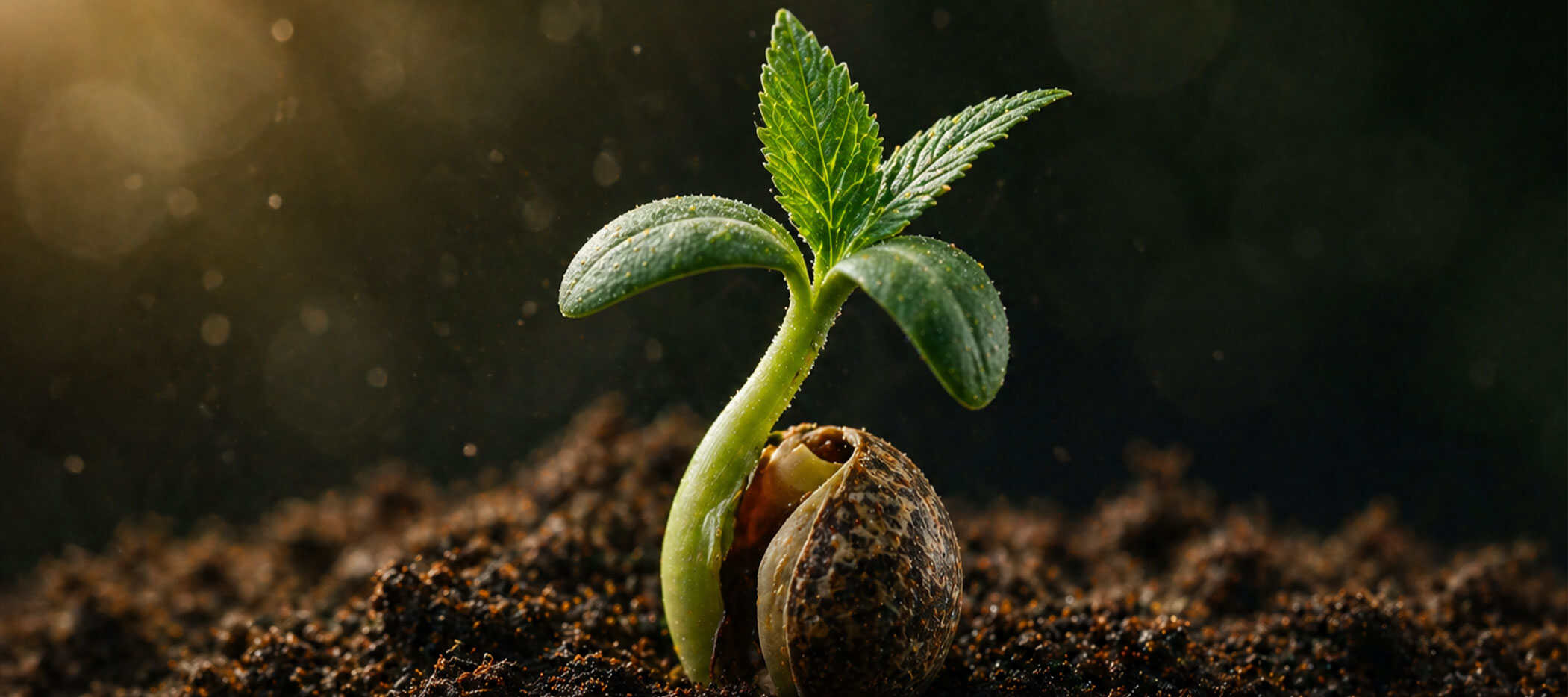
Germination and Seedling Stage
Seeds germinate in rockwool, peat plugs, or paper towels over 2 to 7 days. Once the taproot emerges, the seedling moves into light under gentle conditions — low PPFD (150–300 µmol/m²/s), high humidity (65–75%), and 24-hour or 18/6 lighting. Seedlings stay here 1–2 weeks.
Clones skip seeding entirely and start in a cloner or under a humidity dome for 7–14 days until roots are established. Either way, by week 2–3 the young plants move into the veg room.
Vegetative Growth
Veg is when the plant builds frame. The grower's goal is a strong root system and a wide, even canopy that will support flower later. Veg lasts 4 to 8 weeks; commercial operations often run shorter veg (3–4 weeks) for faster turnover.
- Lighting: 18 hours on, 6 hours off to hold vegetative mode; PPFD 300–600 µmol/m²/s
- Temperature: 72–78°F day, 65–72°F night
- Humidity: 55–70% RH early; taper down as plants size up; VPD 0.8–1.2 kPa
- Feed: nitrogen-dominant nutrient regime, EC 1.2–1.8
- Training: topping, FIM ("f--- I missed") pruning, LST (low stress training), defoliation to open the canopy
- Transplant: plants move from solo cup or 1-gallon to final pot (5–15 gallons) before flip
Flowering Stage
Flipping lights to 12 on / 12 off triggers the shift into reproductive mode. The plant stops building new structure and starts producing flower. Week by week the buds stack, resin develops, and terpenes start expressing.
Week-by-Week Timeline
- Weeks 1–2: stretch phase. Plants can double in height. Canopy management (supercropping, tying down) matters most here.
- Weeks 3–4: pistils emerge; small flower sites develop into bud starts.
- Weeks 5–6: bud swell begins; trichomes multiply across bract and calyx; terpene aroma intensifies.
- Weeks 7–8: dense buds; trichomes transition from clear to cloudy. Anthocyanin (purple) expression may begin with cool night temps.
- Weeks 9–10: ripening. Harvest window opens once trichome ratio hits target. Strain-dependent.
Environmental Targets in Bloom
- PPFD: 800–1500 µmol/m²/s; elite rooms supplement CO2 to 1000–1200 ppm to push higher PPFD
- Temperature: 72–80°F day, drop to 62–68°F in last 2 weeks to encourage color and resin
- Humidity: 50–55% RH early bloom, 40–45% final weeks to prevent bud rot
- VPD: 1.2–1.5 kPa
- Feed: phosphorus and potassium dominant; nitrogen tapers
- Flush: 7–14 days of pure water (or very low EC feed) before harvest to clear residual nutrient salts
Environmental differences across grow styles explain a lot of the final price and character. See our indoor vs outdoor THCa flower guide for the full breakdown.
Harvest
Harvest is the single highest-leverage decision in the grow. Cut too early and potency is immature; cut too late and THCa starts degrading to CBN. A skilled grower reads trichome ratios under a digital microscope, pistil color, and overall bud structure to pick the day.
- Target: 80–90% cloudy trichomes with 10–20% amber for indica-leaning cultivars; higher cloudy percentage for sativa-leaning cultivars
- Cut method: whole-plant chop, branch-by-branch, or selective harvest (top colas first, lower buds 3–7 days later)
- Compliance test: federal hemp rule requires a pre-harvest sample within 30 days; flower must test below 0.3% delta-9 THC or the crop must be destroyed
- Wet trim vs dry trim: wet trim removes fan and sugar leaves immediately after cut; dry trim waits until after drying. Dry trim is common for premium because the extra trichome protection holds up better.
Timing deserves its own guide. See our THCa flower harvest timing guide.
Drying
After cut, whole plants or branches hang upside down in a climate-controlled dark room. The industry standard is the 60/60 rule — 60°F and 60% relative humidity — held for 10 to 14 days. Drying too fast preserves chlorophyll and produces the hay smell of commercial bulk flower. Drying too slow risks mold.
- Target end moisture: 10–12% water content
- Finish check: small stems snap cleanly when bent
- Timing: 10–14 days typical for slow premium dry; 5–7 days for commercial speed
- Airflow: gentle, continuous; avoid fans blowing directly on flower
Trimming
Once dry, buds are removed from stems and trimmed of residual sugar leaves. Two paths here. Hand trimming uses scissors and takes a skilled trimmer 1 to 2 pounds per day. Machine trimming uses tumblers or blade systems and processes 50+ pounds per day. The visual and economic differences are real.
- Hand trim: $150–$300/lb labor; ~5% trichome loss; preserves bud shape and bract detail
- Machine trim: $20–$50/lb; 20–30% trichome loss; buds look rounded, smaller, polished
- Hybrid approach: machine trim with hand finishing is common for mid-shelf
See the full comparison in our hand-trimmed vs machine-trimmed THCa flower guide.
Curing
Trimmed flower moves into sealed containers for the cure. Cure is where the difference between merely dry flower and truly premium flower is made. Residual moisture redistributes through the bud, chlorophyll breaks down further, enzymes continue working, and terpenes stabilize.
- Container: wide-mouth glass jars, CVault stainless, or Grove Bags with TerpLoc film
- Target RH inside container: 58–62%; use Boveda or Integra 62% packs
- Burp schedule: daily in week 1, every 2–3 days in week 2, weekly afterward (Grove Bags don't require burping)
- Duration: 2 weeks minimum; 30–60 days premium; 60+ days for top shelf releases
- Water activity (aw): target below 0.65 to prevent microbial growth while preserving moisture
For the full post-harvest workflow see our complete drying and curing guide.
Testing, Compliance, and Packaging
Before flower ships, every batch goes to a third-party lab for a Certificate of Analysis. Premium operators choose ISO 17025-accredited labs and test a comprehensive panel.
- Cannabinoid potency: THCa, delta-9 THC (must be <0.3%), CBDa, CBD, CBG, CBN, plus total THC calculation
- Terpene profile: 20–40 compounds in mg/g
- Pesticide residue screen against California or Oregon benchmark list
- Heavy metals: arsenic, cadmium, lead, mercury in parts per billion
- Microbial: total yeast and mold, E. coli, Salmonella
- Mycotoxin: Aflatoxins B1/B2/G1/G2, Ochratoxin A
- Moisture and water activity
Packaging happens in cleanroom or controlled environments. Flower is hand-weighed into glass jars with humidity control (Boveda 62% packs are standard), date-coded, batch-labeled, and the COA is either QR-linked or included with the product.
For federal testing requirements see the USDA Hemp Program.
Frequently Asked Questions
Roughly 20 to 26 weeks from germinated seed to finished, cured jar. That breaks down to 1-2 weeks germination and seedling, 4-8 weeks vegetative, 8-10 weeks flowering, 10-14 days drying, and 2-8+ weeks curing.
The production process is identical. The only difference is genetic selection and compliance testing. THCa flower must test below 0.3% delta-9 THC by dry weight at harvest to qualify as federally legal hemp, even though total THC after decarboxylation can be much higher.
Both. Established commercial operations running proven cultivars favor clones because they guarantee phenotype consistency. Smaller and newer grows often start from feminized seeds for genetic vigor and easier legal sourcing.
Post-harvest. Most cannabinoid and terpene loss happens between cut and sealed jar. Drying too fast locks chlorophyll into the bud. Curing too short leaves harshness. Trimming too aggressively strips trichomes. Great genetics are wasted by poor post-harvest handling.
Labor, time, and inputs. Hand trimming costs ten times what machine trimming does. A 60-day cure ties up inventory that could be sold in 14 days. Indoor grows run power-hungry HVAC and lights year-round. Every shortcut taken shaves cost and quality simultaneously.
Functionally no. The grow room, workflow, and goals are identical. The compliance path differs — THCa flower is grown under the federal hemp program and must pass a pre-harvest test for delta-9 THC under 0.3%. State-legal cannabis is grown under state cannabis programs with different testing and tracking requirements.
Key Takeaways
Premium THCa flower is the output of a five- to six-month cultivation process where every decision compounds. Genetics, environment, harvest window, dry, cure, and trim each contribute measurably to the final product.
Clones from vetted mothers deliver phenotype consistency; feminized seeds bring vigor at the cost of slight variation. Veg builds frame; flowering builds flower; harvest timing is where chemistry peaks.
Drying (60/60 rule) and curing (minimum 2 weeks, premium 30–60 days) are where most of the visible quality difference between cheap and premium flower is made. Hand trimming preserves trichomes that machine trimming knocks off.
Every batch should be verified by an ISO 17025-accredited third-party lab across cannabinoids, terpenes, pesticides, heavy metals, microbials, and mycotoxins.
For the full overview of the subject, see our complete guide to THCa flower. To shop batch-verified, hand-trimmed flower, see the current WLX THCa flower lineup.
Ready to shop batch-verified products?
Discover WLX Products →