Two jars of THCa flower from the same farm and the same cultivar can look like different products depending on how they were trimmed. Hand-trimmed flower keeps its shape, its frost, and its bract texture. Machine-trimmed flower often looks rounder, smaller, and less frosty even when it started the same way.
This is an honest breakdown of both methods — what they are, how they differ, what each costs, and what each produces. It builds on our complete guide to THCa flower and complements the buyer's guide to quality THCa flower.
What Trimming Actually Removes
Fresh cannabis buds come off the stem covered in two types of leaves — large fan leaves (5- or 7-bladed, grow outward from stems) and small sugar leaves (grow out of the bud itself, often coated with trichomes). Trimming removes both. The fan leaves always go. The sugar leaves are a judgment call: leave some for trichome content, remove them all for clean presentation.
- Fan leaves: removed entirely; no cannabinoid value, no smokability
- Sugar leaves: usually removed, sometimes partially retained on outdoor or concentrate-feed flower
- Stems: cut down to short pedicels so bud sits cleanly in packaging
- Goal: clean presentation that shows calyx and bract detail, plus smooth smoke
Hand Trimming
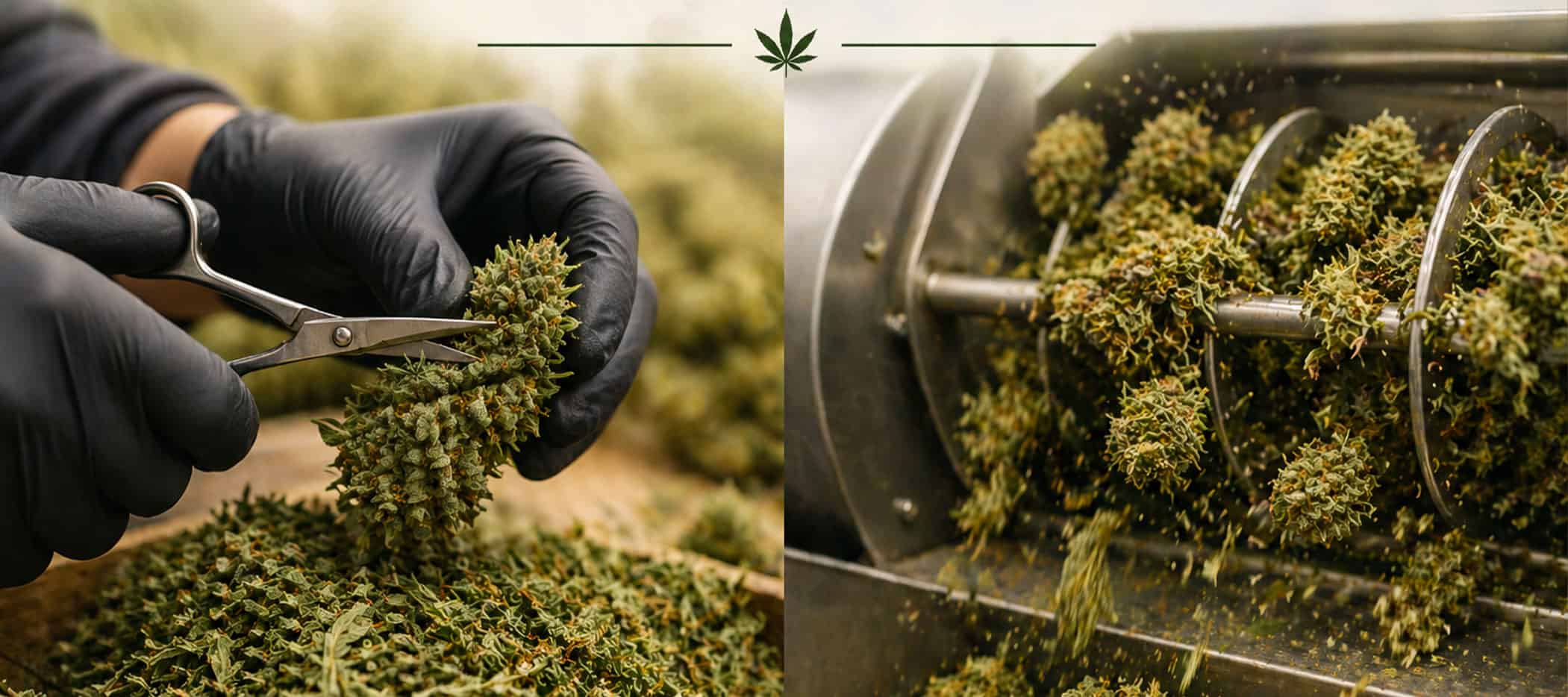
Hand trimming uses fine-tip scissors — often Fiskars, Chikamasa, or similar brands — and a skilled trimmer working bud by bud. Trimmers wear gloves because trichome resin coats their fingers within minutes; the resin itself gets collected as scissor hash, a premium byproduct. A skilled trimmer finishes 1–2 pounds per day.
Hand Trim Pros
- Trichome preservation: approximately 95%+ of surface trichomes intact
- Bud shape: preserved natural structure — indica density, sativa length, hybrid shape
- Bract and calyx visible: the fine texture that makes buds look craft
- Selective trim: trimmer can preserve sugar leaf on specific spots or make judgment calls
- Scissor hash byproduct: premium resin collected from scissor blades
- Visual signature: obvious to a trained eye; justifies premium pricing
Hand Trim Cons
- Labor cost: $150–$300 per pound at skilled wage rates
- Speed: 1–2 pounds per trimmer per day; large harvests require weeks of trim labor
- Inconsistency: trimmer-to-trimmer variation; quality control matters
- Labor availability: skilled trimmers are a seasonal bottleneck in outdoor regions
Machine Trimming
Machine trimming uses one of two systems. Tumble trimmers roll buds inside a perforated drum with rotating blades below that cut protruding leaves. Blade-and-screen systems feed buds onto moving screens with cutting mechanisms. Both can finish 50–200+ pounds per day and dramatically reduce labor cost.
Machine Trim Pros
- Speed: 50–200 lb/day throughput per machine
- Labor cost: $20–$50 per pound
- Consistency: uniform look (though not always ideal aesthetically)
- Scalable: large harvests can finish in days instead of weeks
- Byproduct collection: trim shake and kief collected as secondary products
Machine Trim Cons
- Trichome loss: 20–30% of surface trichomes are knocked off during tumbling or blade contact
- Bud shape: tumbling rounds buds into uniform smaller shapes that lose natural structure
- Over-trim: blade systems sometimes cut into the bud itself, visible as flat surfaces on the calyx
- Visual signature: flower looks polished, uniform, sometimes smaller than hand trim would produce
- No selective work: can't preserve specific areas or make strain-appropriate adjustments
Hybrid (Hand-Finish) Trimming
The middle path that's become common at the A-grade shelf tier. Flower goes through a gentle machine pass to remove the bulk of the fan and sugar leaf, then skilled trimmers hand-finish each bud to correct over-trim, clean up shape, and preserve trichome density on the surface.
- Trichome loss: typically 10–15% (between hand and machine)
- Labor cost: $60–$120 per pound
- Speed: 3–5x faster than pure hand trim
- Visual: closer to hand trim than machine trim; generally passes as "craft" at the A-grade tier
Wet Trim vs Dry Trim
Separate from hand vs machine, there's a timing choice. Wet trim happens immediately after cut while the plant still has moisture. Dry trim waits until after the 10–14 day dry.
- Wet trim: faster because fan leaves remove easily; trichomes are exposed and vulnerable, more terpene loss during drying
- Dry trim: trimmer waits for dry; brittle leaves break off cleanly; more trichome protection during dry; higher labor but better preservation
- Premium operations almost always dry trim
- Commercial operations often wet trim for speed and facility turnover
For the full post-harvest workflow see our drying and curing guide.
How to Tell by Looking
You can generally identify trim method at a glance once you know what to look for.
- Hand-trimmed: natural bud shape, visible calyx swell and bract texture, sugar-leaf edges trimmed but not flush-cut, trichome coat intact from every angle
- Machine-trimmed: rounded smaller buds, polished or slightly matte surface, uniform shape across the jar, reduced sugar-leaf visibility, occasional flat cuts where blades contacted the bud
- Hybrid: cleaner than pure machine but more uniform than pure hand; intermediate size; trichome preservation in the middle
- Over-trim indicator: bract surfaces show flat cuts; you can see cut calyx tissue; tells you the trim went too aggressive regardless of method
Shelf Tier and Pricing Implications
Trim method is a primary pricing signal. Each tier tracks loosely to trim approach.
- Top shelf (exotic): always hand trim; buds should look craft-finished; $50–$80+ per eighth
- A-grade: hand trim or hybrid hand-finish; clean presentation; $30–$50 per eighth
- B-grade: machine trim, sometimes with limited hand finish; $15–$30 per eighth
- Bulk/commercial: machine trim, sometimes wet; minimal cure; <$15 per eighth equivalent
Does Trim Method Affect the Smoke?
Yes, though less than cure or genetics. Better trichome preservation means more visible resin and, at the margin, more cannabinoid and terpene mass per bud. You'll notice the difference at the first inhale of a well-cured hand-trimmed flower vs a machine-trimmed example of the same cultivar:
- Hand trim: smoother ignition, more layered terpene expression, slightly heavier hit
- Machine trim: potency mostly intact; terpene profile slightly muted; visual effect reduced
- Cure and genetics dominate: a well-cured machine-trimmed flower outsmokes a rushed hand-trimmed flower
Frequently Asked Questions
Hand trimming is scissor work done one bud at a time; it preserves bud shape, bract detail, and trichome density. Machine trimming runs buds through tumblers or blade systems that finish fast but knock off 20-30% of surface trichomes and round the buds into generic shapes.
For visual and trichome preservation, yes. The difference is obvious under the loupe and in the jar. Effect and flavor also benefit from better trichome retention, though good genetics and a proper cure matter more than trim method alone.
Labor. A skilled hand trimmer finishes 1-2 pounds per day. Machine trimming does 50+ pounds per day at a fraction of the labor cost. The hand trim premium at wholesale is typically $150-$300 per pound.
Usually. Hand-trimmed buds keep their natural shape, show visible bract texture, and have intact trichome coverage across the surface. Machine-trimmed buds look rounder, smoother, often smaller, with a polished surface and visible trichome loss.
A middle-path approach where flower gets an initial machine trim to remove most of the leaf, then skilled trimmers finish by hand. It's faster than pure hand trim and keeps more trichomes than pure machine trim. Common at the mid-shelf tier.
It reduces surface trichome density, which reduces the visible resin coat. Total THCa percentage on a COA may read similar because the buds themselves still contain cannabinoids, but the consumer experience and presentation suffer. Also, trichome loss from machine trim often gets collected as kief and sold separately.
Key Takeaways
Trim method is a visible quality signal and a real pricing driver. Hand trimming preserves trichomes and bud structure at high labor cost. Machine trimming finishes fast at a trichome cost. Hybrid sits in the middle.
Top-shelf THCa flower is almost always hand-trimmed, dry-trimmed, and hand-finished to a craft standard. That's what you're paying for at the $50–$80 eighth tier.
Mid-shelf (A-grade and B-grade) typically uses hybrid or machine trim with some finishing work. Bulk/commercial flower is usually machine trim and sometimes wet trim, which trades further trichome loss for speed.
Trim matters for visual quality and at the margin for flavor, but cure and genetics dominate the smoking experience. A well-cured machine-trimmed flower can outsmoke a hastily hand-trimmed one.
For the full overview, see our complete guide to THCa flower. For a visual checklist at the shop, see our buyer's guide to quality THCa flower. To shop hand-trimmed small-batch flower, browse the WLX THCa flower lineup.
Ready to shop batch-verified products?
Discover WLX Products →