Ask any experienced grower where cheap flower and elite flower actually diverge and they'll point to the same place: the dry and cure. Great genetics harvested at peak can still end up harsh, hay-smelling, and stripped of terpenes if the post-harvest process is rushed. And average genetics can end up smoking surprisingly well when the dry and cure are done right.
This guide walks through both stages in detail: what's happening chemically, the environmental targets, the tools pros use, and the failure modes at each step. It builds on our complete guide to THCa flower and expands on the post-harvest stages of how THCa flower is made.
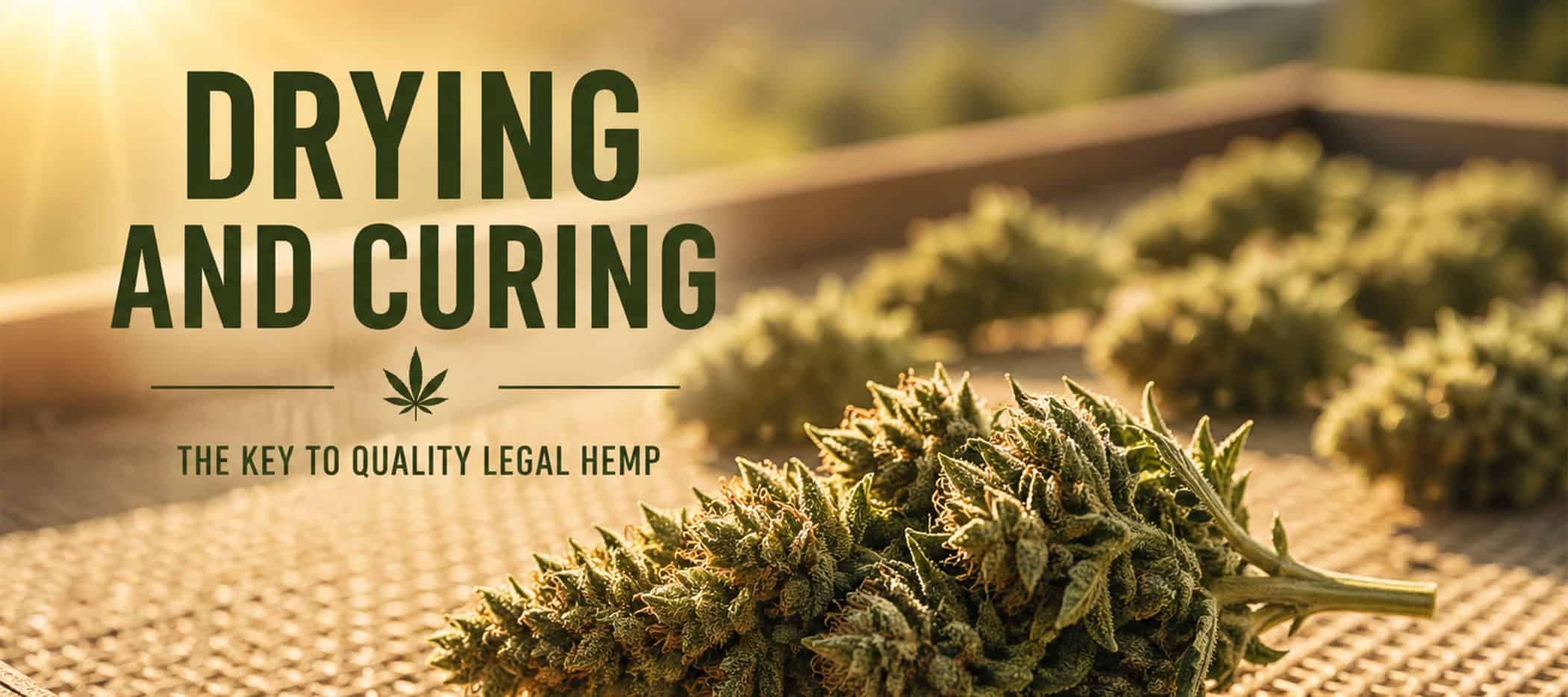
Drying vs Curing: Two Different Stages
The terms get used loosely but they're separate steps with different goals.
- Drying: removing most of the water from fresh-cut flower down to roughly 10–12% moisture in a climate-controlled dark room over 10–14 days.
- Curing: sealing trimmed flower into controlled-humidity containers for weeks so residual moisture redistributes, chlorophyll breaks down, and terpenes stabilize.
Drying is about moisture removal. Curing is about refinement. Skip or rush either and the final product shows it.
Drying: The First Critical Step
Right after harvest, plants are cut and either hung whole upside down (most common for premium) or broken down into branches and hung on racks or wire frames. The dry room is light-tight, cool, and humidity-controlled.
Dry Room Conditions
- Temperature: 60–65°F; never above 70°F (terpene volatility rises sharply)
- Relative humidity: 55–65% held steady; target 60% RH is the industry baseline
- Airflow: gentle and indirect; continuous air exchange without fans blowing directly on flower
- Light: total darkness; UV and visible light both degrade cannabinoids
- Duration: 10–14 days typical for slow premium dry; 5–7 days for commercial speed
The industry calls it the 60/60 rule for shorthand: 60°F, 60% RH. Many modern cultivators dial it in slightly — 62/62 or 64/58 — but the logic is the same. Slow and steady.
How to Tell the Dry Is Done
- Primary check: small stems snap cleanly with an audible crack when bent; they don't bend flexibly
- Moisture: 10–12% water content (moisture meters are used at scale)
- Water activity (aw): below 0.70 (mold growth threshold starts around 0.65)
- Visual: bud holds shape, feels firm but yields slightly
- Smell: grassy notes should be giving way to strain-specific terpene expression; if it still smells like a fresh-cut lawn, dry isn't done
Common Dry Failure Modes
- Dried too fast: chlorophyll locks in; flower smells and tastes like hay. No cure can fully fix this.
- Dried too slow or too humid: mold risk, especially in dense buds; bud rot ruins batches overnight
- Uneven drying: outer surfaces dry while interior stays wet; trapped moisture breeds microbial growth after packaging
- Light exposure: UV bleaches color and degrades THCa; flower loses visual appeal and potency
Trimming Between Dry and Cure
Most premium operations trim dry rather than wet. After the dry is complete, buds are removed from stems ("bucking") and then trimmed of sugar leaves. Dry trimming preserves more trichomes because the leaves are brittle and break off cleanly. Wet trimming is faster but removes some surface trichomes and is more common at commercial scale.
For the full trim comparison see our hand-trimmed vs machine-trimmed guide.
Curing: Where Flower Becomes Premium
Trimmed flower moves into sealed containers at a controlled humidity. Cure is the slow chemistry that turns merely-dry flower into smooth, aromatic, premium product. Several things happen during cure:
- Residual moisture redistributes from the stem and center of the bud to the outer surfaces
- Chlorophyll and other pigments continue breaking down, reducing the vegetal harshness of fresh-dry flower
- Enzymatic activity continues for a short time, refining terpene expression
- Sugars and starches continue breaking down, smoothing the smoke
- Terpene profile stabilizes as volatile compounds equilibrate inside the sealed container
Cure Containers
Three container types dominate the premium cure workflow.
- Wide-mouth glass jars: classic choice. Easy to visually inspect; inexpensive; require manual burping. Half-gallon and gallon jars common at commercial scale.
- CVault stainless containers: food-grade stainless with silicone seal and built-in Boveda holder. Better light protection than clear glass; durable for repeated use.
- Grove Bags (with TerpLoc film): passive humidity-control bags. The film regulates moisture bidirectionally without burping. Used at scale in modern operations.
Humidity Control
- Target RH inside container: 58–62%
- Boveda 62% packs: two-way humidity packs; replace when they stiffen
- Integra Boost: similar two-way packs, sometimes preferred for flavor
- Monitoring: hygrometer inside jars during cure; monitor for mold risk (above 65% RH), over-dry (below 55% RH), or uneven reads that signal moisture pockets
Burping Schedule
Burping is opening the container briefly to vent moisture and swap air. It's critical in the first two weeks.
- Week 1: burp 1–2 times daily for 5–15 minutes; check for ammonia smell (indicates microbial growth; flower should be removed and re-dried)
- Week 2: burp every 2–3 days for 10–15 minutes
- Week 3+: burp weekly; many cultivators stop burping once humidity stabilizes
- Grove Bags: no burping required when sealed properly
Cure Duration
- Minimum acceptable: 2 weeks
- Solid premium standard: 30–60 days
- Top shelf releases: 60–90+ days
- Diminishing returns past 90 days in most strains; some terpene profiles continue refining up to 6 months
Most of the transformation happens in the first 4–6 weeks. You'll feel the difference between 14-day and 45-day cured flower on the first inhale.
Water Activity and Mold Risk
Water activity (aw) is a measure of unbound water available for microbial growth. It's different from total moisture content because it reflects what microbes can actually use. Premium flower targets 0.55–0.65 aw.
- Below 0.55: flower is too dry; brittle bud, lost terpenes
- 0.55–0.65: target zone; stable, smooth, no mold risk
- Above 0.65: mold risk rises sharply; state compliance labs will flag
- Many states require aw below 0.65 on the COA
A cultivator who burps consistently and monitors RH rarely has aw problems. One who packages flower before the cure has stabilized ends up with microbial failures on COA tests.
Storage After Cure
Once cure is complete, flower is packaged for sale — typically in sealed glass jars, mylar pouches, or Grove Bags with a humidity pack. From that point, the consumer's job is preserving what the grower built. Cool, dark, airtight, and 58–62% RH is the formula. See our how to store THCa flower guide.
Frequently Asked Questions
Drying removes most water from the flower in a controlled environment over 10-14 days. Curing happens after drying, when trimmed flower sits in sealed containers for weeks while residual moisture redistributes, chlorophyll breaks down, and terpenes stabilize.
60°F and 60% relative humidity held steady for the duration of the dry, typically 10-14 days. It's the industry standard for slow-drying premium flower without losing terpenes or risking mold.
Minimum 2 weeks. Premium producers target 30-60 days. Top-shelf releases often cure 60+ days. Most of the smoothness and flavor development happens in the first 4-6 weeks of cure.
Grove Bags use passive humidity-control film (TerpLoc) that maintains 58-62% RH without burping. Boveda packs are two-way humidity packs that release or absorb moisture to hold a target RH. Both are used to protect flower during and after cure.
Not really in the first 3-6 months with proper storage. After that, terpenes slowly degrade regardless of cure technique. The more common failure mode is under-curing, which leaves flower harsh and hay-smelling.
Chlorophyll gets locked in, producing the hay or grass smell of cheap flower. Terpenes evaporate rapidly at higher temperatures. Bud structure can collapse as outer surfaces dry while interior stays wet, trapping moisture and risking mold.
Key Takeaways
Drying and curing are where premium THCa flower is actually made. Everything before — genetics, environment, harvest timing — is potential. The dry and cure realize it.
Drying targets 60°F and 60% RH in darkness for 10–14 days. The endpoint is small stems that snap cleanly and moisture around 10–12%. Rushed drying locks in chlorophyll and produces the hay smell of cheap flower.
Curing happens in sealed containers with 58–62% RH (Boveda packs or Grove Bags) for a minimum of 2 weeks, with 30–60+ days being the premium standard. Burping is critical in the first two weeks; Grove Bags skip the burp.
Water activity (aw) below 0.65 is the safe zone for long-term storage without microbial risk. A properly cured and packaged jar of flower stays in peak condition for 6–12 months.
For the full overview of THCa flower, see our complete guide to THCa flower. To shop flower from small-batch cultivators who cure for 30+ days, browse the WLX THCa flower lineup.
Ready to shop batch-verified products?
Discover WLX Products →