Two jars of THCa flower at the same price can be wildly different products. The gap isn't always visible in the label or even the advertised THCa percentage — it shows up in trichome coverage, bud structure, smell, and the Certificate of Analysis. Once you know what to look for, evaluating flower becomes quick.
This is a practical buyer's checklist. It pulls from the production side (see how THCa flower is made) and translates it into what you can actually inspect before or at the point of sale. It builds on our complete guide to THCa flower.
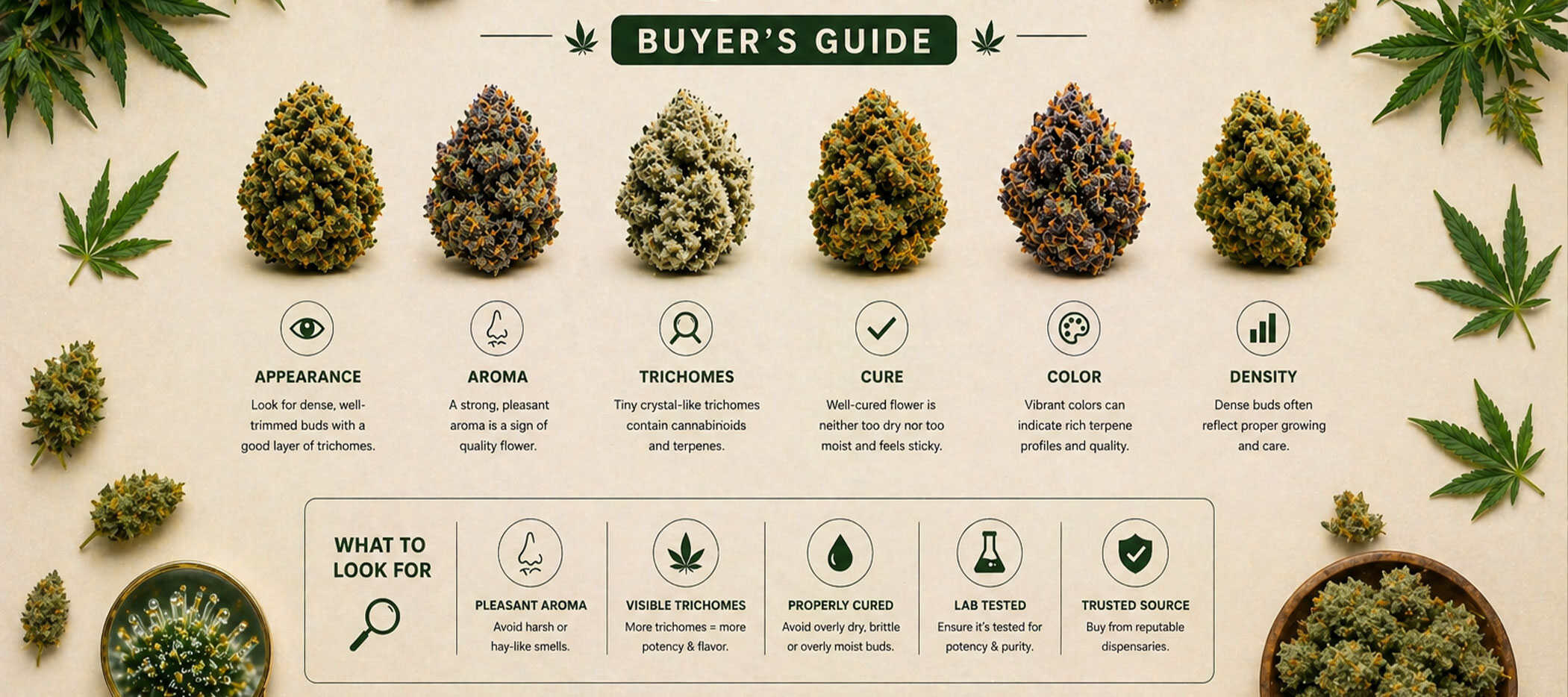
The Quality Checklist
The seven markers below compound. No single one decides the flower — premium product ranks well on all of them.
1. Trichome Coverage
Trichomes are the resin glands where THCa and terpenes are produced. Premium flower looks frosted to the naked eye. Under a loupe or 30x microscope, trichome heads should be intact and predominantly cloudy (milky) in color, with some amber depending on strain and harvest intent.
- Dense frost across calyxes and sugar leaves = good trichome preservation through dry, cure, and trim
- Patchy or stripped-looking surfaces = machine trimming or rough handling
- Clear trichomes only = harvested too early
- Majority amber with few cloudy = harvested late; sedative heavy
2. Bud Structure
Bud should be dense enough to hold its shape when gently squeezed, then spring back. Indica-leaning strains are rounder and tighter; sativa-leaning strains are longer and looser. Either way, the bud shouldn't crumble, shatter, or feel spongy.
- Firm with slight give = good cure and proper moisture
- Rock-hard and crumbly = over-dried or old
- Soft and squishy = under-dried, risk of mold
- Loose and airy with obvious stems = loose-structured strain or poor genetics
3. Color
Deep, vivid green is the base. Pistils (hairs) should be vibrant orange, red, or brown. Some strains express purple, violet, or blue pigmentation from anthocyanin production triggered by cold night temps in late flower. The visual target is saturation and contrast.
- Deep green + bright pistils + frost = typical premium signature
- Purple streaks or tips = strain and environment signature, not a quality guarantee
- Pale, yellowish green = light bleaching, heat stress, or old flower
- Brown, gray, or black spots = mold risk; do not consume
4. Smell
Open the jar. A quality flower should immediately express a loud, specific terpene profile. Diesel, gas, citrus, floral, fruit, vanilla, earth — whatever the strain is built for, you should smell it within seconds. Weak, flat, or hay-like smells signal lost terpenes from poor dry or old storage.
- Loud, specific, strain-appropriate = fresh, well-cured
- Pleasant but muted = older flower or rushed cure
- Hay or grass = dried too fast, chlorophyll retention
- Ammonia or sour = microbial growth; reject
5. Moisture Level
The quickest physical test: break a small stem or squeeze a small bud. Small stems should snap cleanly with a quiet crack; buds should yield slightly to pressure and bounce back to shape. Either extreme is a problem.
- Snaps cleanly + bud returns to shape = ideal (~11% moisture)
- Stems bend before snapping = still wet, needs more dry/cure time
- Dusty on the jar sides + bud shatters = too dry or old stock
6. Trim Quality
Hand-trimmed flower keeps bud shape and bract texture intact. Machine-trimmed flower looks rounder, smaller, and sometimes polished. Over-trim shows as chipped bract surfaces and visibly cut calyxes. Under-trim leaves sugar leaves still attached.
- Clean hand trim = premium shelf signal
- Tumbled-round machine trim = commercial; trichome loss visible
- Unchucked sugar leaf = budget or farm-direct flower
For more see our hand-trimmed vs machine-trimmed comparison.
7. COA Verification
This is the one non-negotiable marker. Every batch of legitimate THCa flower should have a current Certificate of Analysis from an ISO 17025-accredited third-party lab, dated within the last 12 months and matching the batch you're buying.
- Cannabinoid panel: THCa matches stated potency; delta-9 THC < 0.3%
- Terpene panel: dominant terpenes align with the strain's known profile
- Pesticide residue: all results pass (California or Oregon standards are strictest)
- Heavy metals: arsenic, cadmium, lead, mercury below ppb limits
- Microbial: total yeast and mold, Salmonella, E. coli all pass
- Mycotoxin: Aflatoxins B1/B2/G1/G2, Ochratoxin A all pass
- Moisture and water activity listed
- Batch and sample dates clearly printed
If a vendor can't show you a real COA, walk.
Red Flags That Save You Money
A handful of signals reliably predict bad flower. Any one of these should give you pause; two or more and it's a pass.
- No visible COA or a COA that's more than 12 months old
- COA from a lab you can't verify (search the lab name and check for ISO 17025 accreditation)
- THCa percentage listed without a delta-9 THC number on the COA
- Smell faint, stale, or chemical rather than plant-forward
- Dry powder or "kief dust" in the bottom of the jar (heavy trichome loss)
- Visible stems protruding or larf-heavy bud (popcorn sites mixed with A-buds)
- Pricing dramatically below market (<$10/gram flower at scale) — usually means sprayed or distillate-coated
- Any white powdery substance on the surface that isn't trichome (powdery mildew)
Understanding Shelf Tiers
The industry informally uses tier language that roughly tracks these markers. It's not formalized but it helps set expectations.
- Top shelf (exotic): 26%+ THCa, hand-trimmed, 30–60 day cure, heavy trichome coat, loud terpenes. $50–$80+ per eighth.
- A-grade: 22–26% THCa, hand or hybrid trim, 2–4 week cure, solid visual. $30–$50 per eighth.
- B-grade: 18–22% THCa, usually machine or hybrid trim, shorter cure, acceptable quality. $15–$30 per eighth.
- Bulk/commercial: variable THCa, machine trim, quick dry, minimal cure. $5–$15 per eighth equivalent.
Price isn't a perfect proxy for quality — a skilled small farm can undercut a big brand — but it roughly tracks the craft-input cost.
Storage Preserves (or Destroys) Quality
Flower that arrives premium can degrade fast in bad storage. Keep it airtight, dark, at 58–62% RH, and between 60–70°F. Boveda or Integra 62% packs hold humidity automatically. See our how to store THCa flower guide for details.
Frequently Asked Questions
It looks frosted under the light from heavy trichome coverage, has dense and intact bud structure for its strain type, shows vivid green with clear pistil and sometimes purple coloration, and has been trimmed without over-cutting into the bud. Dusty, flat-green, spongy, or hay-smelling flower is not quality.
Partially. A high THCa percentage confirms genetic potential and harvest timing, but it doesn't tell you anything about terpenes, cure, smoothness, or experience. A 24% THCa flower with full terpene expression and a 60-day cure can smoke better than a 30% flower that was rushed.
Check that it's from an ISO 17025-accredited lab, confirm the batch number matches the product, verify delta-9 THC is under 0.3%, check THCa matches the claim, review the terpene profile, and make sure pesticide, heavy metal, microbial, and mycotoxin panels all pass.
Deep green with vivid orange or red pistils, often with purple or violet accents on cold-finished strains. A frosted white-silver sheen from trichomes should be visible. Yellow, brown, or pale flower signals poor storage, heat stress, or old stock.
Quality flower should be slightly sticky from resin — you should feel trichome residue when handling it. But it shouldn't be wet or squishy (that's under-dried or under-cured) and it shouldn't crumble to dust (that's over-dried or old). A firm bud that returns to shape after a gentle squeeze is the target.
Look at the pack date and the COA sample date. Fresh THCa flower is usually 2-6 months from harvest. Beyond 12 months, terpenes noticeably degrade and THCa slowly converts to CBN. A strong, distinct terpene smell is the best freshness indicator — stale flower smells faintly of hay or nothing.
Key Takeaways
Quality THCa flower is readable before you smoke it. Trichome coverage, bud structure, color, smell, moisture, and trim tell you almost everything; the COA confirms the rest.
High THCa percentage is a positive signal but isn't the whole story. A well-cured 22% flower with full terpene expression outsmokes a rushed 30% flower. Let your nose and eyes weigh as heavily as the label number.
Never buy without seeing a current COA from an ISO 17025-accredited lab. Verify cannabinoids, terpenes, pesticides, heavy metals, microbials, and mycotoxins all pass. A missing COA is an immediate disqualifier.
For the full picture of what goes into premium THCa flower, see our complete guide to THCa flower. To shop batch-verified, small-batch THCa flower that ranks well on every marker above, browse the WLX THCa flower lineup.
Ready to shop batch-verified products?
Discover WLX Products →